06 Oct 2025
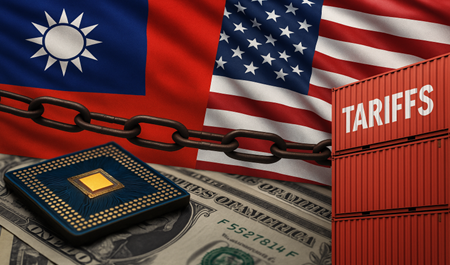
THE SILENT WARFARE OF CHIPS AND TARIFFS
It began with a diplomatic snub. Earlier this year, South Africa ordered Taiwan to move its Liaison office out of Pretoria and downgrade its status to a commercial mission in Johannesburg. For Pretoria, it was a symbolic gesture of alignment with Beijing’s “One China” policy and with China as its powerful BRICS counterpart. For Taipei, it was a public humiliation. Taiwan retaliated swiftly, announcing on 23rd September that most chip exports to South Africa would, from November 2025, require government approval.
These are not ordinary goods. Chips have been described by writers like Christopher Miller as the “new oil”. “Semiconductors may be to the 21st century, what oil was to the 20th”, wrote Larry Summers. In the last century, oil shaped economies, influenced wars and touched daily lives; today semiconductors play a similar role. They underpin everything from AI and smartphones to robotic toys and smart weapons, and Taiwan’s dominance gives it leverage few others can match. It is estimated that Taiwan produces over 60% of all semiconductors globally and more than 90% of the most advanced chips.
The restrictions were suspended almost as quickly as they were announced - South Africa sought consultations and Taiwan weighed the reputational risk of being seen as an unreliable supplier.
But the incident left its mark, showing how trade in strategic goods can be weaponised in an instant.
Nations have long used trade to exert pressure. Napoleon’s Continental System tried to strangle Britain’s economy by blocking its access to European markets. OPEC’s oil embargo in the 1970s reshaped global politics, sent prices soaring and left drivers queuing for hours at petrol stations. The same dynamic is now playing out on a much larger scale. In Washington, tariffs have become the default tool of trade policy, with new duties on electric vehicles, solar panels, batteries and other green technologies making daily headlines. Tariffs are no longer limited to China: most trading partners have felt the sting, South Africa among them, with US tariffs on steel and aluminium adding cost and uncertainty for local producers.
What began as Trump-era bluster has hardened into policy. In the last 24 hours, Washington has imposed new tariffs on lumber and furniture, all while demanding that Canada, a major lumber exporter, accept quotas on steel and aluminium and open its protected dairy market to US producers. The transactional nature of tariffs is also evident in the pressure being brought on Mexico to tighten migration controls and on the countries like Eswatini, Liberia and Sierra Leone to accept the relocation of foreign criminals as a price of maintaining trade preferences. Tariffs, like chips, have become instruments of silent warfare.
Chips and tariffs differ in their mechanics. Export licences target specific goods at source. Tariffs, on the other hand, strike at a country’s borders and sweep across entire categories of goods. Both disrupt the flow of critical goods, distort markets and create leverage. Each carries a dual edge. They can inflict pain on a target country, but they also invite retaliation or reputational damage. If Taiwan makes chip exports a matter of politics, customers may look to other suppliers like Korea. If the US leans too heavily in favour of tariffs, it risks undermining the global trade on which much of its prosperity has been built.
The line between legitimate regulation and economic coercion is increasingly blurred.
This silent warfare over chips and tariffs is not just about economics. It is about governance: how nations exercise power, how companies manage risk, and how supply chains have become the front line of global politics. These are some of the pressures I explore in my new book on corporate governance (to be published by LexisNexis in November 2025), which examines how boards and executives can navigate an environment where regulation, politics and commerce are increasingly inseparable
Abstract:
The silent warfare of trade is no longer waged behind closed doors — it is playing out in chips, tariffs and supply chains.
South Africa’s recent diplomatic spat with Taiwan showed how semiconductors - the “new oil” - can be turned into leverage overnight. Meanwhile, the US’s tariff campaign has gathered pace. with fresh duties on lumber and furniture and demands that Canada, Mexico and even small African states make political concessions as the price of trade. What appears to be routine policy is, in fact, a contest of power. I explore this in my new piece, The Silent Warfare of Chips and Tariffs, which also previews some of the pressures examined further in my forthcoming book on corporate governance (LexisNexis, November 2025).