
Latest Articles

Authored by Lindsay O’Connor , General Manager Content Pacific & Content Strategy APAC For years, legal technology has promised greater efficiency. Firms have invested in research platforms, document...

The use of artificial intelligence in legal practice continues to mature. While early adoption focused on discrete applications such as drafting assistance, document summarisation, and research support...

This blog was originally published in 2025 and has been updated in March, 2026 to reflect Protégé General AI’s updates. As AI becomes more common in legal practice, many professionals are discovering...

This blog was originally published in 2020 by Professor Sharon Christensen, Queensland University of Technology, and has been updated in the Australian Property Law Bulletin in 2026 to reflect current...

Authored by Alison Cripps , Head of Workplace, In-House and Technology, Practical Guidance “It’s just a smart precinct pilot - nothing major.” Two meetings later, the diagram tells a different story...
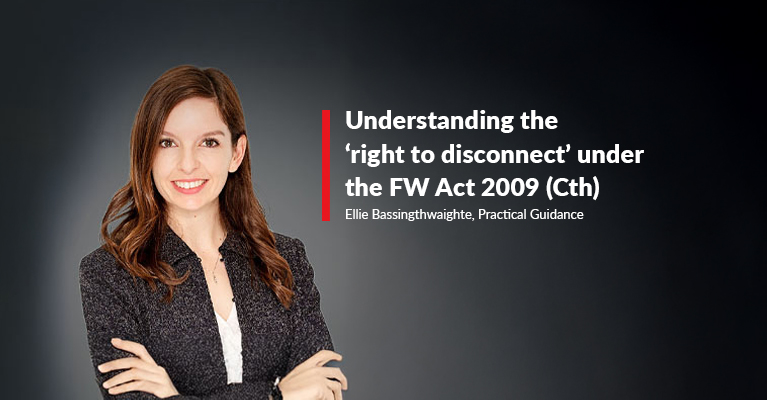
Ellie Bassingthwaighte Senior Legal Writer - Employment for LexisNexis® Practical Guidance, is an experienced workplace lawyer who has worked at the Fair Work Commission, before practicing in employment law and industrial relations since 2014.
In this article, she discusses the key considerations for employers and employees under the new worker rights recently enshrined under the Fair Work Act 2009 (Cth) (FW Act).
The ‘right to disconnect’ under the Fair Work Act
The ‘right to disconnect’ passed through parliament on 12 February 2024 and received royal assent on 26 February 2024. Since the provisions commence six months after royal assent, the ‘right to disconnect’ won’t take effect until August 2024.
This means businesses have some time to familiarise themselves with the new law and develop strategies for managing the restrictions on out-of-hours contact with employees.
Defining the ‘right to disconnect’ under the Fair Work Act
The ‘right to disconnect’ is not as straightforward as the name might suggest.
Instead of a blanket right to ignore out-of-hours contact, employees will have the right to refuse to monitor, read or respond to contact (or attempted contact) from their employer, where the contact is outside of the employee’s working hours, unless the employee’s refusal is unreasonable.
Employees will also have the right to refuse to monitor, read or respond to out-of-hours contact (or attempted contact) from a third party, where the contact relates to their work, unless the refusal is unreasonable.
The rights of refusal are workplace rights for the purpose of Part 3-1 of the FW Act, meaning that the employer is prevented from taking adverse action against an employee who exercises or proposes to exercise this right.
What is considered reasonable in the context of the ‘right to disconnect’ under the Fair Work Act?
Considering whether the employee’s refusal is reasonable or unreasonable will require an examination of the following factors:
- the reason for the contact or attempted contact;
- how the contact or attempted contact is made;
- the level of disruption caused to the employee;
- the extent to which the employee is compensated:
- to remain available to perform work during the period in which the contact or attempted contact is made; or
- for working additional hours outside of the employee’s ordinary hours of work,
- the nature of the employee’s role, including their level of responsibility;
- the employee’s personal circumstances (such as their family or carer responsibilities); and
- whether the contact is required under a law of the Cth/state or territory (in which case, any refusal would be unreasonable).
Having regard to the above factors, it is apparent that some of the extreme predictions about the effect of this law – such as, employers being prevented from contacting employees above shift covers – are unlikely to come to pass. However, the vast middle ground between contact that is clearly reasonable and contact that is clearly unreasonable is likely to be a fertile source of disputes.
For example, what happens when an employee who receives a salary in excess of their minimum entitlements, but who also consistently works unpaid overtime, is called on to respond to additional out-of-hours contact? To what extent can an over-award payment be applied to offset unpaid overtime and additional out-of-hours contact?
How do law firms manage clients who might have an expectation that the lawyer assigned to their matter, is contactable at their convenience?
Does an employee with young children have a greater claim to uninterrupted leisure time than an employee with no children?
Disputes and orders about the ‘right to disconnect’
Where there is a dispute regarding the operation of s333M of the FW Act, parties should attempt to resolve the dispute at the workplace level.
If these discussions are unable to resolve the issue, then a party to the dispute may apply to the Fair Work Commission (FWC) to either make an order or otherwise deal with the dispute.
Once an application is made to the FWC, the FW Act will require that the FWC deal with the application as soon as reasonably practicable and within 14 days.
If the FWC is satisfied that the employer’s out-of-hours contact is unreasonable and the employer is likely to:
- take disciplinary action against the employee; and/or
- continue to require the employee to monitor, read or respond to contact,
the FWC may make an order to prevent the employer from taking disciplinary action and/or to prevent the employer from continuing to require the employee to monitor, read or respond to such contact.
If the FWC is satisfied that the employee has unreasonably refused to monitor, read or respond to contact or attempted contact, and there is a risk that the employee will continue to do so, the FWC may make an order that prevents the employee from continuing to unreasonably refuse out-of-hours contact.
What are the next steps?
Once the ‘right to disconnect’ commences, employers will no longer have an unfettered right to contact their employees out-of-hours and expect a response. Accordingly, employers should review their practices regarding out-of-hours contact with employees in advance of the provisions commencing.
For example, consider whether that late night email or weekend text message is absolutely essential, or if they can wait until the next business day. Think about the cost of the intrusion into the employee’s personal life against their total remuneration, in assessing whether it is reasonable to expect them to respond to out-of-hours contact. Finally, open a dialogue with employees about when they feel comfortable being reached outside of work hours. Some employees may not mind responding to such contact, while others want total separation.
Employment Law Practice Area Collection
LexisNexis provides extensive coverage of federal and state employment law across our many publications. Authored by leading experts in the field, these analytical works include commentary and analysis on employment, industrial and occupational health and safety law. The flagship title Workplace Law Fair Work contains extensive annotations to the Fair Work Act as well as commentary on workplace discrimination, paid parental leave, termination of employment, and much more. Practical Guidance Employment is a how-to solution for workplace law practitioners, human resources professionals and in-house counsel dealing with workplace law matters. It provides task-oriented guidance supported by on-point cases, legislation, checklists, precedents, time-saving tools, and white-label training materials, covering the dynamic employment law landscape. Learn more by visiting Legal Research.