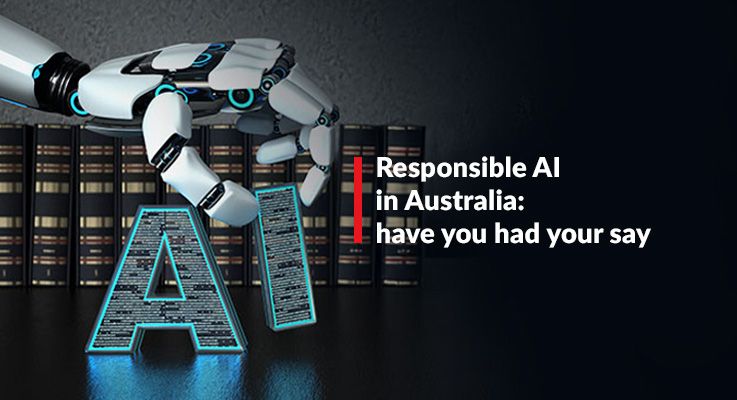
The growth of artificial intelligence technologies in Australia has recently come under the spotlight, as the Albanese Government looks to review existing regulatory and governance mechanisms and establish applicable safeguards that are fit for purpose in the current day and age.
On the 1st of June, industry and science minister Ed Husic launched a new consultation with the release of Supporting responsible AI: discussion paper asking interested parties to share views on how the Australian Government can mitigate potential risks of AI and support safe and responsible AI practices. Submissions collected over eight weeks closed on 26 July 2023.
Explore the full Advancing Together: June/July 2023 article today.
Supporting the consultation, the paper Rapid Response Report: Generative AI which was commissioned by Ed Husic in February to come up with a scientific basis for discussions about the way forward, was also released on Thursday, 1 June.
“…we commissioned the Prime Minister’s National Science and Technology Council to look at the whole development of generative AI and large language models and to give advice to government on that,” Mr Husic said at a press conference in Australian Parliament House on the release of the papers. “Then we also wanted to see what we could do in terms of modernisation of our legal frameworks to account for this, bearing in mind there’s probably a dozen different laws that currently exist that take into account the impact of AI and have some sort of response. But clearly, recent developments require us to think further.”
While Australia already has some safeguards in place, the speed of AI innovation seems to have set off a significant level of community concern and business anxiety prompting government action around the world.
The latest consultation in Australia is an effort to build on the current government’s longstanding commitment to safe and responsible use of AI.
“Using AI safely and responsibly is a balancing act the whole world is grappling with at the moment,” Mr Husic said. “The upside is massive, whether it’s fighting superbugs with new AIdeveloped antibiotics or preventing online fraud.”
Shadow Communications Minister David Coleman thinks the Australian government is moving too slowly.
“It is the biggest technology development since the creation of the internet itself,” Mr Coleman said. “And it’s got lots of great opportunities, in terms of improved productivity, in terms of medical research, a whole lot of areas. But there are risks too and it’s appropriate to consider those risks. It’s appropriate for Government to be cognizant of those risks.”
Elements that require urgent attention according to the shadow minister include intellectual property and data collection & retention.
“This is a gargantuan issue where we’ll be talking about this for months and years and decades,” the minister added. “It’s a huge deal. And you’ve got obviously the generative AI, ChatGPT and so on. But also the broader issue of, I guess, what’s called artificial general intelligence, which is as technology gets smarter and smarter and better at doing more and more tasks. And that can have some positive implications but can have some negative implications, too. So, I think we should be optimistic.
I think we should be positive, but we should also have the intellectual honesty to recognise that there are some risks here. And we want a government that doesn’t overregulate, that doesn’t step on the technology. But is also smart enough to be thinking about what’s coming down the track and ensuring that Australia retains control of its laws.”
With debate continuing across the legal and most other industries - about responsibly integrating AI into the future of work LexisNexis® Vice President, Regulatory Compliance- Global, Myfanwy Wallwork, recently sat down to discuss responsible AI and ethics with Linda Przhedetsky, an Associate Professor at the University of Technology Sydney’s Human Technology Institute. Listen to the conversation by visiting the second episode of the AI Decoded podcast series.