
30 Mar 2026
Drafting Reinvented: Lessons from History and the Next Leap Forward
Every generation of lawyers has experienced a shift in how legal work gets done.
From handwritten documents to form books, from typewriters to word processors, from templates to digital workflows: each evolution compressed time, reduced friction, and reshaped expectations.
Now, drafting is entering its next era.
In a recent LexisNexis® webinar, Drafting Reinvented: Lessons from History and the Next Leap Forward, Aaron Crews, Partner in the Innovation Practice Group at Holland & Knight, and Zackary Gibbons, Technical Sales Director for DMS, API & Drafting Solutions at LexisNexis, explored what this transformation means for law firms, and why this moment is different.
The Compression of Change
Historically, technological change in legal practice unfolded over decades.
Today, that runway has vanished.
As Gibbons explained:
“Where there may have been centuries between handwritten documents and typewriters, and decades between typewriters and word processing, we’re now seeing fundamental shifts happen in three-, four-, five-year increments.”
For firm leadership, this compression has strategic consequences. Firms no longer have the luxury of waiting for technology to mature.
“If you’re waiting for perfection,” Gibbons noted, “you’re going to fall behind.”
Crews reinforced the urgency:
“Failing to get on board quickly is an existential threat. The horizon is moving away at an ever-faster pace.”
For AmLaw firms, this isn’t about experimentation. It’s about competitive positioning.
Source: LexisNexis webinar poll
From pilot programs to infrastructure
In the early stages of generative AI, firms cautiously explored isolated pilots. That stage is over.
AI is moving from curiosity to core operational capability, especially in drafting, where lawyers spend between 40% and 60% of their time.
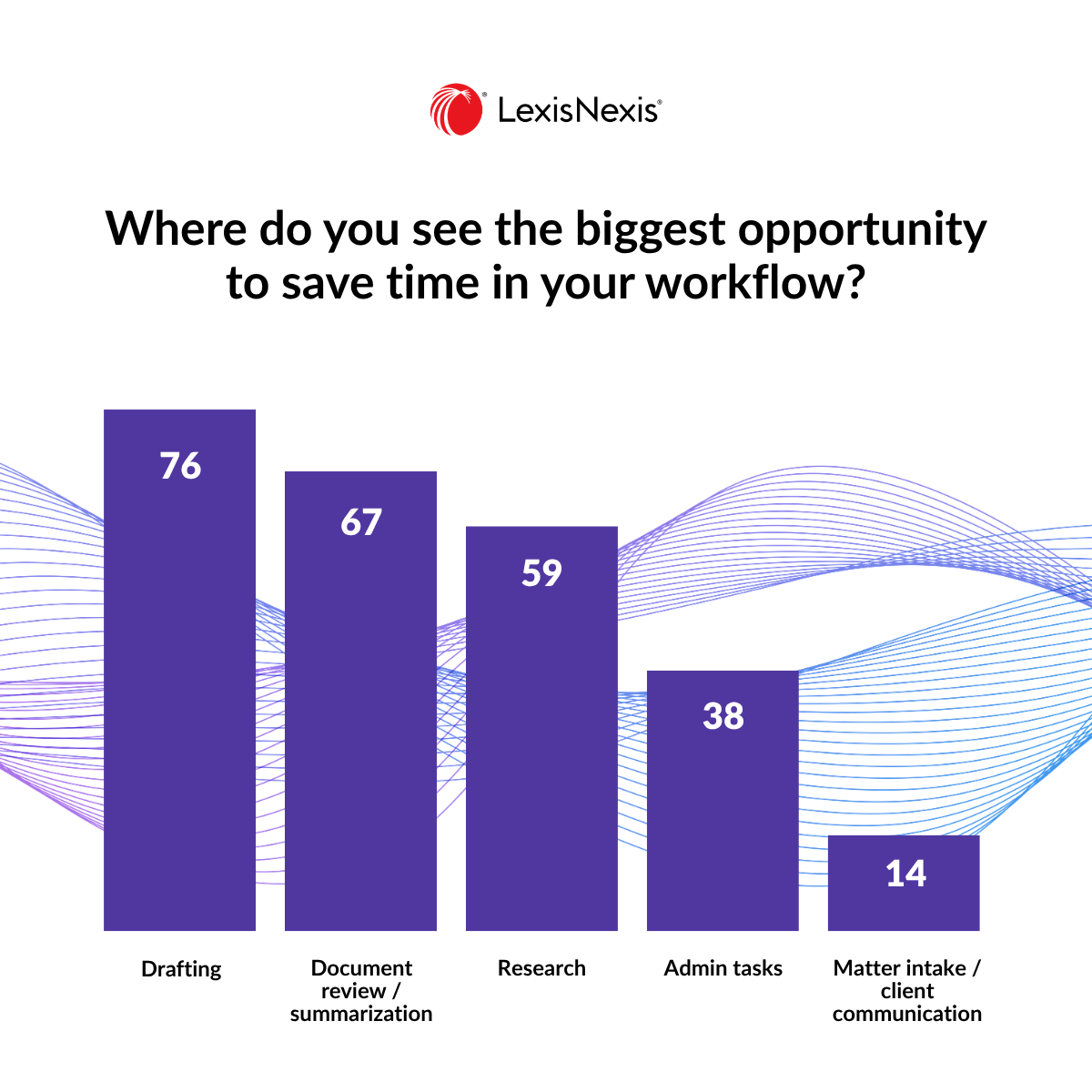
That focus is echoed by practitioners themselves. In the webinar audience poll, drafting emerged as the single largest opportunity for time savings, with nearly 30% of all responses selecting drafting workflows over research, review, or administrative tasks.
What’s changing is not just adoption, but expectation.
Firms are building AI into line-item budgets. Attorneys are using it daily. And clients are beginning to assume it’s part of competent representation.
The question is no longer whether AI can assist drafting. It’s how firms integrate it responsibly, securely, and strategically.
Understanding the AI Stack: Not Just One Tool
A major theme of the discussion was clarity around what “AI” means in a legal drafting context.
Crews and Gibbons emphasized that effective drafting workflows are rarely powered by a single model. Instead, they combine:
- Deterministic tools for exactness and structured outputs
- Predictive machine learning for relevance and pattern recognition
- Generative AI for drafting, summarization, and synthesis
As Crews explained:
“Your best, most effective legal workflows are generally going to be a combination of these technologies rather than any one of them.”
This layered approach is critical for enterprise-grade drafting. Deterministic systems ensure compliance with firm standards. Predictive systems surface the right precedent. Generative models accelerate drafting and synthesis.
Together, they create infrastructure — not just automation.
The 80/20 Inversion
Perhaps the most compelling concept discussed during the webinar was what Crews referred to as the “80/20 inversion.”
Historically, lawyers have spent much of their time gathering and organizing information, often 80%, and only 20% applying strategic analysis and judgment.
AI changes that equation.
“AI may cause the 80/20 inversion,” Crews said. “Eighty percent of time was spent collecting information, and 20 percent was strategic analysis. We’re trying to flip those timeframes.”
Audience responses reinforce this shift. Beyond drafting, document review and research were the next highest-ranked areas for time savings, highlighting how much attorney time is still consumed by information synthesis rather than strategic thinking.
For law firm leadership, this is transformative.
The opportunity is not merely to reduce drafting time, but to elevate the value of attorney time.
As Crews shared from his in-house experience:
“People hire attorneys for judgment. These technologies allow you to understand things faster so you can exercise judgment in a deeper and faster way.”
In other words, AI doesn’t replace attorneys. It amplifies their expertise.
Adoption Is the New Competitive Divide
One of the most striking moments in the conversation came when the speakers addressed fears about AI replacing lawyers.
Gibbons reframed the issue:
“It’s not a matter where AI is replacing attorneys. Attorneys that are adopting AI are going to replace those that do not.”
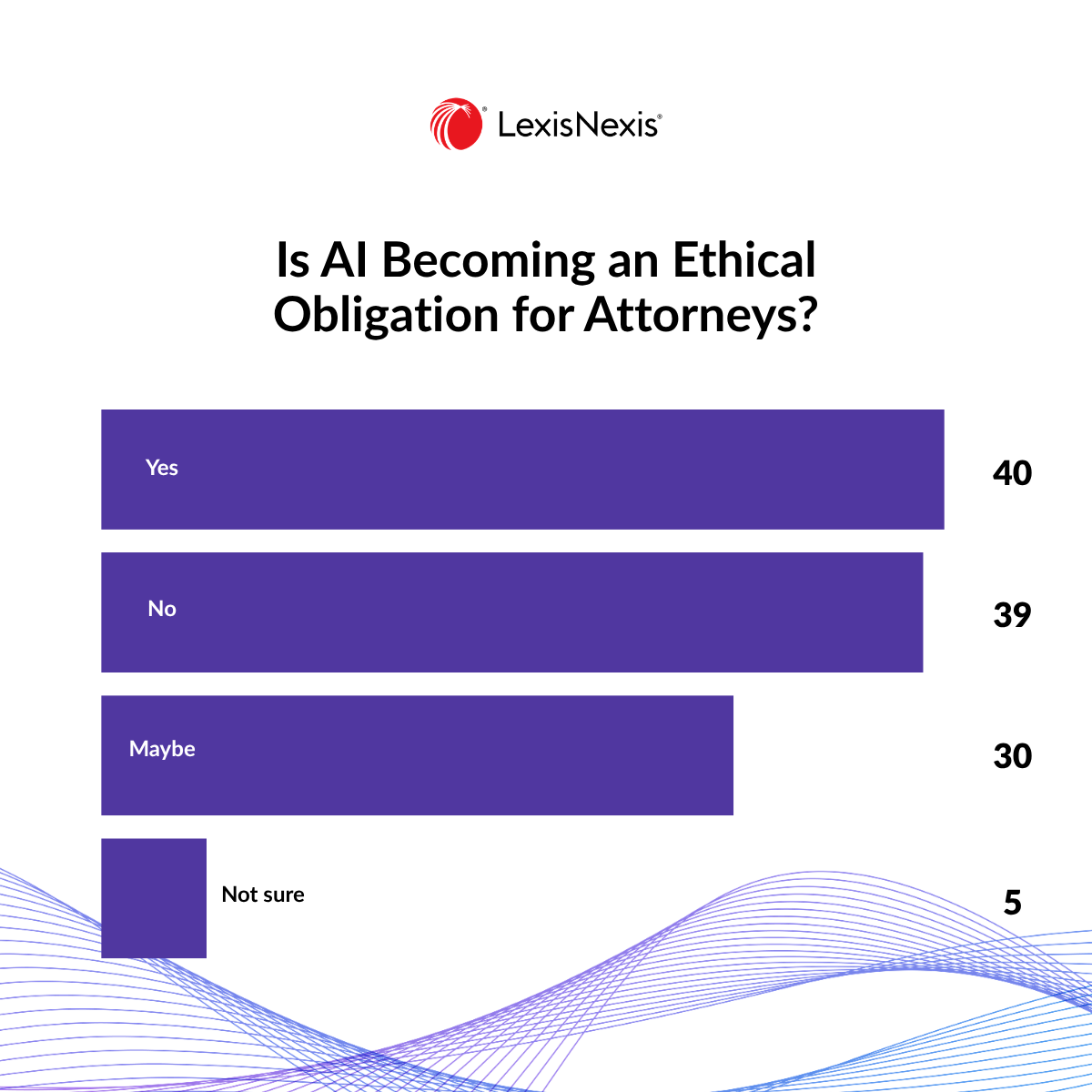
Yet, the path forward is not universally agreed upon. When asked whether attorneys have an ethical obligation to use AI, the audience was nearly evenly split between “yes,” “no,” and “it depends,” signaling a profession still actively working through the implications of adoption.
Source: LexisNexis webinar poll
In competitive markets, especially at the AmLaw 200 level, marginal efficiency gains compound. Firms that operationalize AI drafting can:
- Respond faster
- Surface insight sooner
- Deliver higher consistency
- Improve client service quality
Meanwhile, firms that delay risk losing ground — not because AI is perfect, but because it is improving rapidly.
Governance, Variability, and Human Oversight
The discussion also addressed a common concern: variability in generative AI outputs.
Large language models (LLMs) do not produce identical outputs each time because they are probabilistic systems, generating content based on statistical predictions rather than fixed rules.
But that variability, Crews noted, mirrors human drafting behavior:
“An associate attorney drafting a motion is never going to produce the same brief twice.”
The key is governance.
Enterprise-grade drafting AI must include:
- Human-in-the-loop review
- Clear audit trails
- Structured guardrails
- Defined workflows
This emphasis on responsible adoption aligns with audience sentiment, where many respondents indicated that AI use depends on the matter, practice area, or risk profile, underscoring the importance of control, transparency, and oversight.
Responsible adoption is not about blind automation. It’s about intelligent integration.
What This Means for the Next Era of Drafting
Legal drafting is not disappearing. It is evolving.
As firms confront increasing volumes of information — from expanding case law databases to growing internal document management systems — the traditional “needle in a haystack” challenge becomes unsustainable.
AI-powered drafting shifts the burden of information synthesis from the attorney to the system.
The result?
More time for strategy.
More time for client counseling.
More time for high-value work.
And that is where competitive differentiation lives.
Building Drafting Infrastructure with Lexis Create+
The future of drafting will not be defined by standalone AI tools. It will be defined by integrated, secure, enterprise-ready infrastructure.
Lexis Create+ embeds AI-powered drafting directly into Microsoft Word — combining:
- Deterministic accuracy
- Predictive relevance
- Generative acceleration
- Enterprise governance and auditability
It is designed not as an experiment, but as a drafting architecture, purpose-built for the scale and expectations of modern law firms.
The Strategic Question for Law Firms
Technology cycles are compressing. Client expectations are rising. Competitive pressure is intensifying.
Encouragingly, the webinar itself reflected strong alignment with market needs—over 90% of attendees indicated the session met their expectations, and nearly all rated the panel as knowledgeable—reinforcing that firms are actively seeking guidance in this area.
Firms that treat AI as a strategic element of their drafting infrastructure, not just a productivity tool, will define the next era of legal practice.
The question is no longer whether drafting will change.
It already has.
The question is whether your firm will lead that change — or respond to it.
For more insight, watch the full webinar here.
Or, read the LexisNexis white paper expanding on these ideas.