
Harnessing Change in Law Firms: Turning Challenges into Opportunities
Harnessing Change in Law Firms: Turning Challenges into Opportunities
The only constant in life is change – especially in a corporate context. This is where change management comes into play to manage change and development in a targeted manner and take employees with you.
Change management refers to the targeted planning, control, and support of change processes in companies. It comprises strategic, organizational, and communicative measures to implement change professionally at both an individual and organizational level and to anchor it in the long term. In addition to entrepreneurial aspects, the focus is particularly on employee involvement and acceptance. Change projects are structured initiatives with clear objectives and defined procedures that aim to bring about lasting change in structures, processes, or behaviour.
Whether digital transformation, new market requirements or internal restructuring – law firms today are under constant pressure to change. Growing client expectations, changes in the market, stronger competition and technological innovations make it necessary to (re-)act quickly and in a targeted way.
When and where is change management recommended?
Frequent reasons for failing change projects are lack of acceptance, unclear communication or resistance from the workforce – all because of a missing structured change management. Change management ensures that changes are not only planned but also implemented effectively and sustainably.
Not every change requires comprehensive change management though. But the bigger the change, the more important a systematic approach is. Typical application scenarios for change management are, among other, the digitization of business processes, the introduction of new software solutions, management changes and strategy adjustments.
And sometimes there is a combination of all of these – e.g. when you implement a CRM solution to steer and manage your client relationships and to funnel your business development initiatives effectively. The management and successful implementation not only of the software solution as such, but also of the cultural change that comes along with it, is the essence of change management in this regard. The change managers play a critical role in this: they combine strategic planning with communicative support and ensure acceptance of the change.
The major tasks in this process are:
- The identification of demand for change, by early investigating market changes, new technologies or internal challenges;
- The development of action plans, by defining strategies and measures to push the change in a structured manner and target-oriented;
- The coordination of communication, by creating trust and orientation through transparent information transfer in a target group-oriented way; and
- The support for employees, by training and educating, using feedback formats and continuous dialog.
Change management methods
The overall goal is that changes are accepted and implemented sustainably, and to overcome the attitude “we have always done it that way – why should we change?”. To achieve this, you need effective methods which include:
- Communication planning promoting transparency and trust;
- Stakeholder analysis identifying and evaluating the interests and influencing factors of all stakeholders to derive targeted measures;
- Change roadmaps as visual schedules showing clearly all measures, milestones and responsibilities;
- Employee surveys and continuous feedback loops to improve the change process and promote acceptance; and
- Storytelling & visual facilitation (images, metaphors and stories) helping to convey complex topics in an understandable and memorable way
Change management success factors
As every project, change management requires planning with SMART goals, but also SMART reporting to measure the success of the project. To sum it up: Just be smart in everything you do.
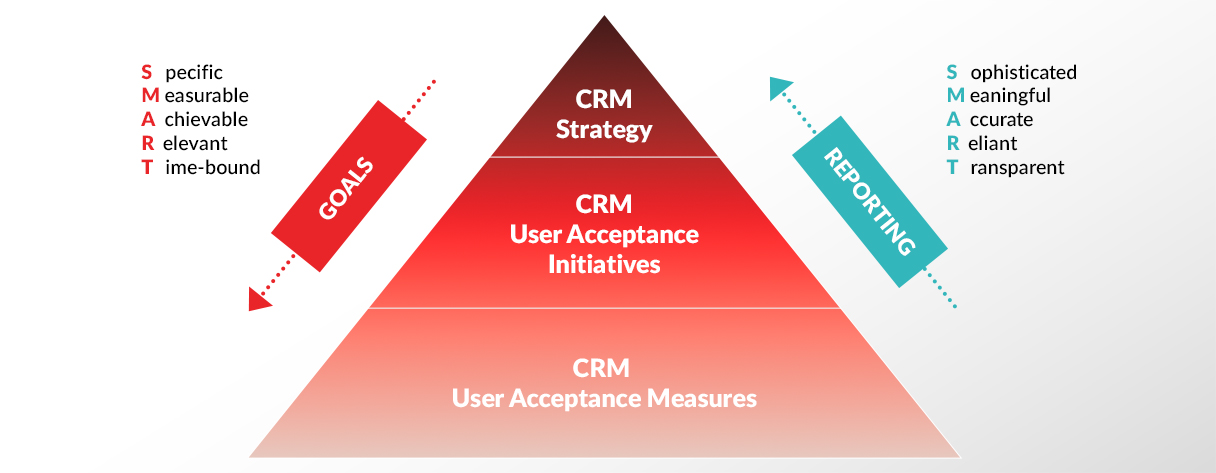
Furthermore, it is essential that the employees are involved early in the project as those who are involved at an early stage develop understanding, commitment and a sense of responsibility for the change. This has to be aligned with a sophisticated communication strategy that is transparent and target group-oriented to create trust and guidance. Also of major importance is the management and other leaders within the organisation acting as role models. They must live and breathe the corporate culture that supports the change. But it is also essential to have key users in place who can provide important feedback from day-to-day work and thus make a decisive contribution to user acceptance.
How the nature of a project can have an impact on the change management
The introduction of new IT solutions – especially such as a CRM system – is so much more than just a technical project. Processes, ways of thinking and the understanding of client relationships will be affected fundamentally by the implementation of this new tool. Without a professional change management, the acceptance of the new system, the new processes and the new way of thinking can suffer – with the result that potential remains unutilised and the risk of the investment not paying off as expected. CRM systems have a deep impact on sales, marketing and services processes. Therefore, it is crucial to consider change management as an integral part of the implementation of a new CRM solution to increase its acceptance within the organisation and make the most of it.
But what if…? How to make the project a success despite the obstacles
There is always resistance – especially when familiar structures or ways of working are questioned. As mentioned before: “Why should we change something that has worked well so far?” Whereas open rejection is relatively easy to identify (e.g. through objections, criticism or complaints), hidden resistance is more difficult to recognise and often manifests itself indirectly (e.g. through loss of motivation, questioning decisions that have already been made, detailed discussions or excessive concerns as well as delays in project-related tasks). It is essential to recognise resistance at an early stage and actively address it without delay.
Analysing potential resistance at an early stage, transparent communication, actively involving employees, trainings and making added value visible are only a few tools to deal with resistance, able to create quick successes and promote acceptance at all levels.
Conclusions
- Purchasing a CRM solution is only on step of many on a long way to rolling it out and using it smartly.
- Implementing a CRM solution is not an IT project – there are many stakeholders involved (CRM, IT, BD, Marketing, Management, Users)
- A structured change management process is required to holistically consider and integrate all business areas affected by the introduction of the CRM system.

Client Advisor, InterAction+
During more than 25 years of professional experience in international law firms, Christine has gained substantial user experience with InterAction. From being a user assisting partners and their legal team, later a power user dealing with Marketing and Business Development work, she finally had the chance as interim CRM manager to roll out the CRM solution in a German major law firm with more than 400 users. Thus prepared, she started in June 2022 as Client Advisor Europe at LexisNexis InterAction and contributes her broad expertise in supporting continental European and South African clients in the strategic use of the system, working closely with Marketing and Business Development teams developing strategies to support the entire client lifecycle, leveraging the capabilities of InterAction to streamline processes and increase efficiency. She also provides guidance and support to ensure that users are able to effectively utilise the technology and make informed, data-driven decisions.