
Transforming Data Overload into Actionable Insights: A Strategic Approach to Law Practice Growth
by Christine Kaiser
August 27, 2025
Having a business development background, this is a comfortable playing field for me. I love working strategically and laying the ground for successful, effective and efficient development of the business. And I doubt that there can be something like a smart decision if you do not have any strategy in place. Building the strategy is only the first step on your way to implementing it and to thrive your business accordingly. Elas, we are talking about Change Management – again! You simply cannot overdo Change Management – just think of volatile market situations, constant competition, changing legal requirements – literally everything is in flux, at all times. Change is a constant everywhere. Therefore, it is essential to have a stable yet flexible business development strategy in place which also includes an aligned and supporting data strategy.
Where to Begin: Establishing a Reliable Data Foundation
Going back to smart decisions: How smart can a decision be if it is not based on reliable data? But is your data reliable? Find out by taking stock of the current situation: Check all relevant resources, meaning technology, processes and people. It is essential that you dig deep and disclose ALL data, data sources, processes and involved employees to get the bigger picture of the status quo.
In conducting a thorough assessment, you will find your stage on the Digital Maturity curve and be able to answer the question whether your firm is Reactive, Organised, Digitised, Connected or Intelligent.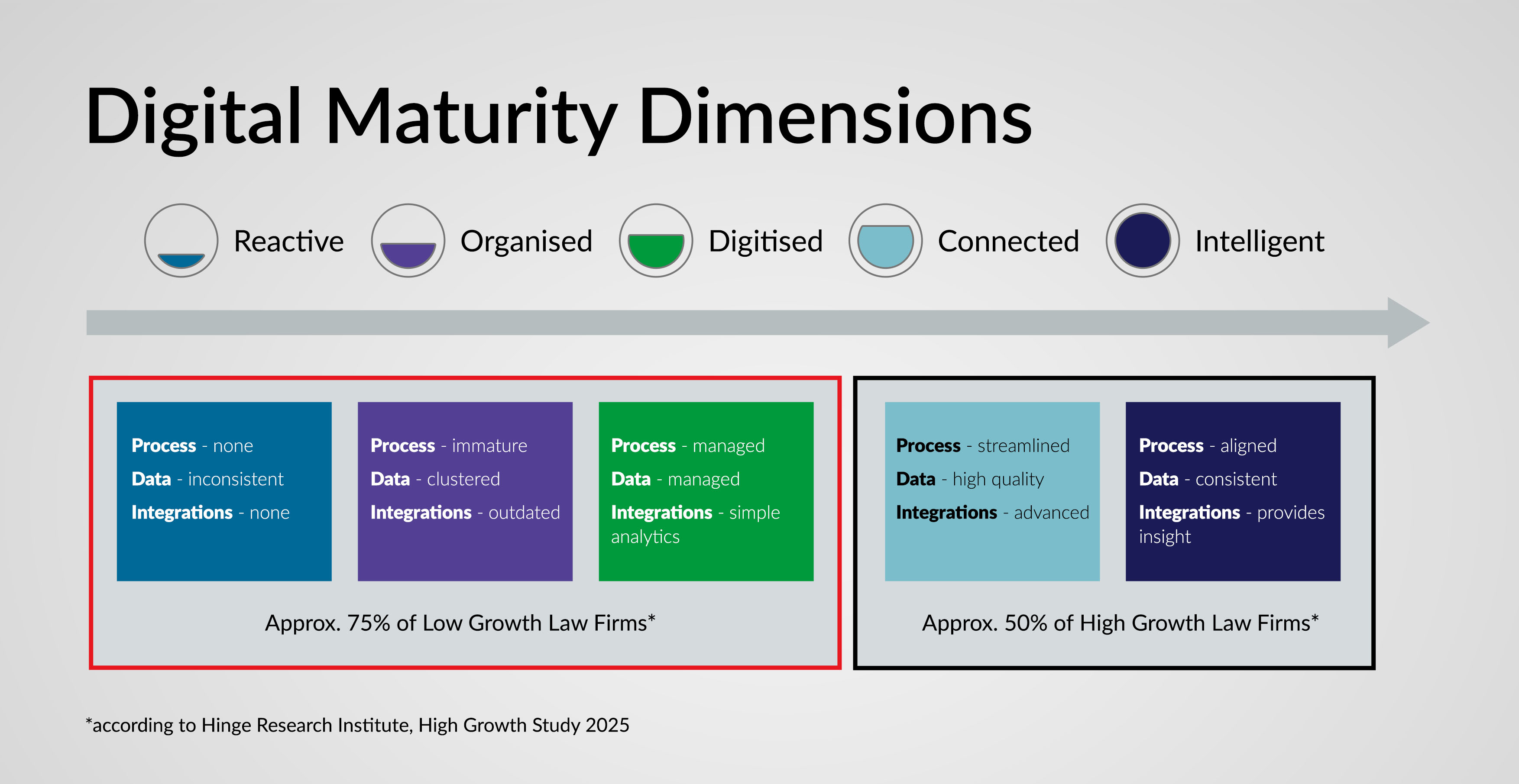
To know where you stand is important to find a way into the future. In their latest edition of the High Growth Study, the Hinge Research Institute has discovered that about ¾ of the Low Growth Law Firms were digitally reactive, organised or digitised whereas about 50% of the High Growth Law Firms were at least connected or even intelligent. This means that the better you organise your data, the more likely you are to be successful in the market. At Lexpo on 17 June in Amsterdam, representatives of law firms were asked what they reckoned being a common challenge with respect to data in their firms. Not surprising: “Compliance” an “Effectivity” were the most frequently mentioned answers. Compliance comes along with data security and effectivity is a result of integration and consolidation – both are the outcome of a successfully implemented data strategy.
Assessing Digital Maturity and Identifying Gaps
Your current data landscape is helping you identifying gaps and overlaps in data management. Consider the overall IT strategy of your firm — all solutions must be aligned with each other to streamline processes and be efficient, as well as future developments regarding people, processes and technology, but also business and market trends. Only then you can develop a roadmap for integration and consolidation. A quick and dirty consolidation can be achieved by reporting on data harvested from different sources. This leaves the risk of data being outdated in one or the other system, though. The far more sophisticated and reliable way to get rid of the abundance of data in various disconnected sources is to overcome the siloed approach and integrate the systems into one Single Source of Truth that shall prevail other solutions and provide comprehensive insight into your data. This choice and decision mark the moment your data strategy is born!
Aligning Your Data Strategy with Business Goals
Align your data strategy with your business goals, use data to drive targeted marketing campaigns and optimize operational workflows based on data insights. By using GenAI, you can, e.g., enhance your client relationship management through predictive analysis. You no longer have to rely on reporting on data from the past only; you can also consider forecasting trends and, thus, provide solid decision support.
Of course, this new approach requires some changes in the business – in the data environment, in processes, in your staff. This is where professional Change Management is required. Do not forget that culture eats strategy for breakfast!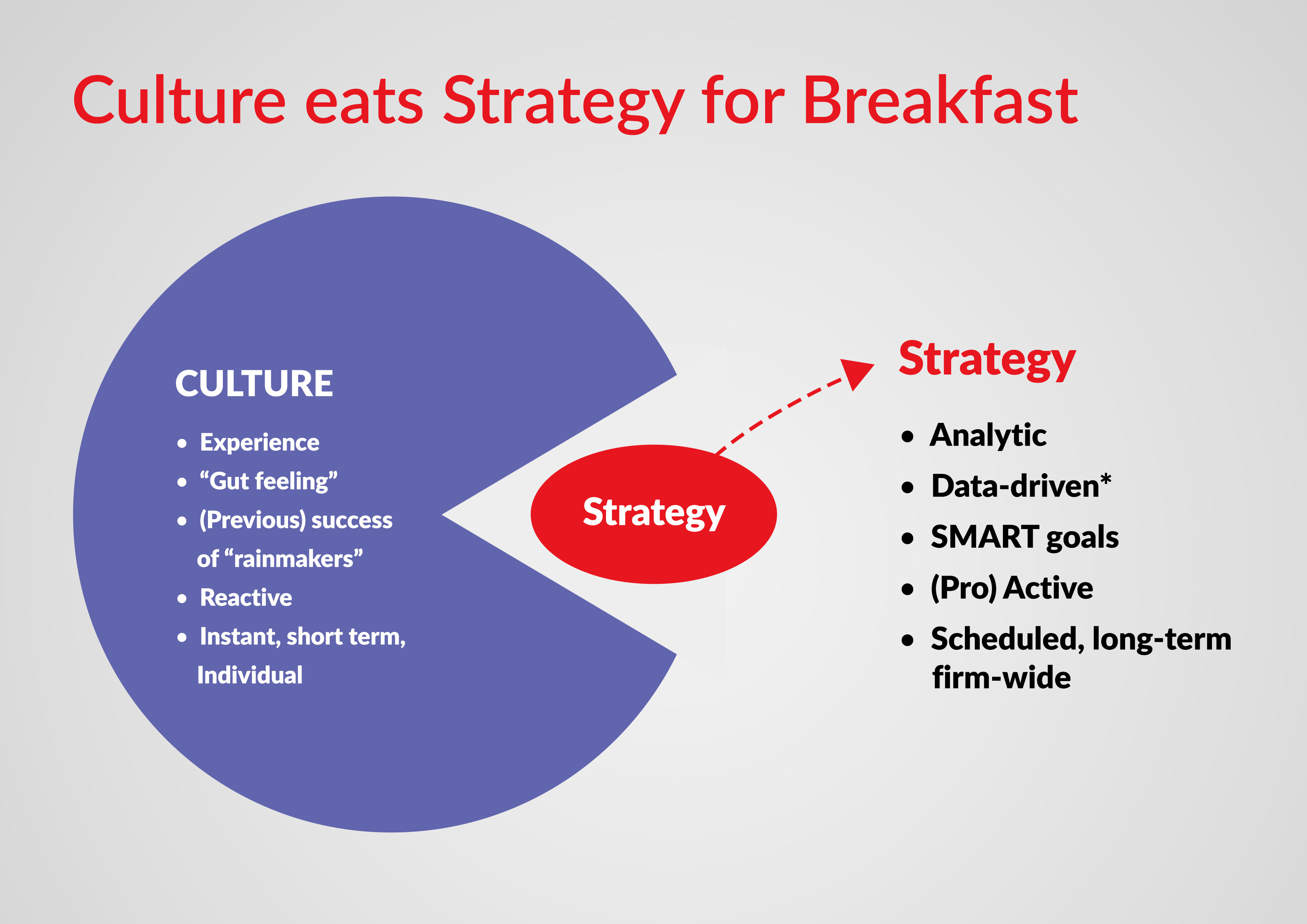
Embracing Change Management for Successful Implementation
As humans are creatures of habit, they are regularly sceptical of change, sometimes even rejecting it. The more fundamental the change is perceived to be, the harsher the opposition. New technologies or just new ways of operating with the existing software solutions require training and support as well as continuous and transparent cross-departmental communication to get your employees committed and to overcome adoption challenges. End user acceptance and adoption play a big role in evolving digital maturity. Since it is important to keep them engaged; why not incentivize the use of data through clear benefits and measurable outcomes? Show your users that every click counts and educate them about what’s in it for themselves, for the firm, but also for the clients.
Proceeding with a Purposeful and Measured Approach
However drastic the change may be, proceed carefully and take your time. Remember – whether you want to run a sprint or a marathon – both require you to take them step by step to cross the finish line.
Looking for more business of law strategies? Check out our complimentary e-Guide to Legal BD or watch our SME education session titled, "Behind Every Smart Decision is a Data Strategy".

Client Advisor, InterAction+
During more than 25 years of professional experience in international law firms, Christine has gained substantial user experience with InterAction. From being a user assisting partners and their legal team, later a power user dealing with Marketing and Business Development work, she finally had the chance as interim CRM manager to roll out the CRM solution in a German major law firm with more than 400 users. Thus prepared, she started in June 2022 as Client Advisor Europe at LexisNexis InterAction and contributes her broad expertise in supporting continental European and South African clients in the strategic use of the system, working closely with Marketing and Business Development teams developing strategies to support the entire client lifecycle, leveraging the capabilities of InterAction to streamline processes and increase efficiency. She also provides guidance and support to ensure that users are able to effectively utilise the technology and make informed, data-driven decisions.