
Latest Blogs
Arbitration continues to grow in importance across Canada, not only in domestic and international commercial disputes, but increasingly in areas such as employment, family, and consumer law. In a recent...
Summary: As AI adoption accelerates across the legal industry, Canadian legal professionals are asking important and necessary questions about accuracy, data privacy, and reliability. This article...
In the legal world, the billable hour has long been the standard for measuring productivity and profitability. But as artificial intelligence (AI) continues to reshape industries, forward-thinking legal...
Discover the LexisNexis ® Trust Center — your trusted source for security, privacy, and compliance information across LexisNexis Legal & Professional solutions. The Trust Center brings everything together...
Summary: Understanding Shadow AI The Shifting Responsibilities of Leadership Recommended Actions to Tame Shadow AI Conclusion The fast growth of AI tools offers big opportunities but also...
By:
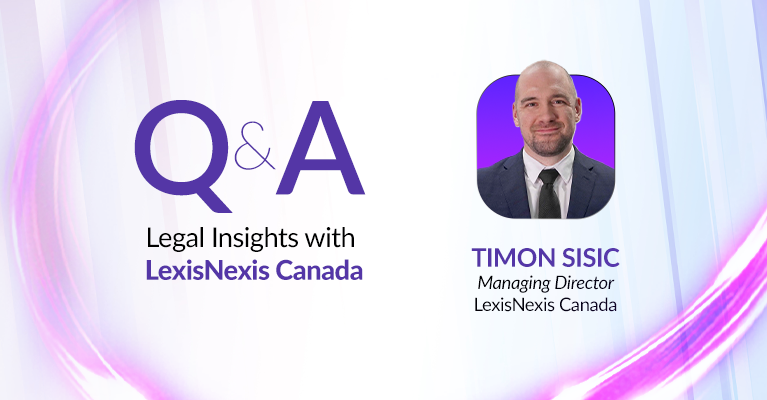
Timon Sisic, Managing Director, LexisNexis Canada
Summary:
As AI adoption accelerates across the legal industry, Canadian legal professionals are asking important and necessary questions about accuracy, data privacy, and reliability.
This article addresses:
- Frequently Asked Questions about Lexis+ AI
 with Protégé, answered by Timon Sisic, Managing Director, LexisNexis Canada (former civil litigator)
 - How LexisNexis® Canada uses trusted content, human expertise, and a secure infrastructure to support your full legal workflow
Question - LexisNexis Canada is often associated with legal research. How does the organization go beyond research to support the full legal workflow?
Timon - For years, LexisNexis Canada has been developing products and curating content that go well beyond traditional research. However, our long legacy dating back to Lexis Advance® Quicklaw® still leaves users with the impression that we are “the legal research organization”. This perception is reinforced by the fact that we continue to offer the strongest Canadian case law collection and the fastest legislative updates on the market.
That said, for years we’ve offered products that extend well beyond traditional legal research:
- CaseMap+ is a strong example. While users can integrate legal research into CaseMap+, at its core it has always been a solution designed to manage litigation matters, organize evidence and structure case strategy — supporting the full lifecycle of a case, not just research.
- Practical Guidance is another. The quintessential image of Practical Guidance is not a case citation, but step-by-step processes that go far beyond simply “finding the right case.” For more than a decade, it has provided structured, practice-focused direction. And now with Protégé, we have brought that capability even further to the forefront.
- Nexis Diligence+ further reinforces this evolution. It is not about case law research at all, but about risk assessment, background checks, and investigative due diligence that helps professionals make informed decisions with confidence.
Together, these solutions demonstrate that our value proposition has always extended beyond legal research into workflow enablement, litigation management, and risk intelligence.
That said, it can sometimes be challenging to shift perception when our brand is so strongly associated with legal research. When you do something exceptionally well, it naturally becomes what people know you for.
Question - What capabilities does Lexis+ AI offer that public AI tools such as ChatGPT, Claude, Gemini, and other general-purpose LLMs do not?
Timon - The answer is straightforward: Public LLMs like Claude, ChatGPT, and Gemini don’t have access to our proprietary content including millions of cases, hundreds of authoritative texts written by renowned legal experts, thousands of expert-authored templates and precedents, or our extensive collection of journal articles, newsletters, and news publications.
While there are numerous feature-level differentiators that I don’t have space to cover here (that’s what a demo is for), the most meaningful distinction is the content itself. Our depth, scale, and quality of proprietary legal intelligence is not something general-purpose LLMs can replicate.
When clients need reliable, defensible, and professionally grounded legal AI, access to trusted, expert-authored content is what truly sets Lexis+ AI apart.
Question - Where is customer data stored, and what are the data retention policies of LexisNexis Canada? How does Lexis+ AI protect privacy and secure customer data?
Timon - The data is stored in Canada (with some processing occurring in the EU for select items). We do not process customer data in the Unites States of America. We’ve made our security compliance and data processing very accessible and easy to understand and can be accessed any time in our Trust Center
Question - How does Lexis+ AI work? And how do you make sure the responses are accurate?
Timon - Every response generated in Lexis+ AI includes direct links to the underlying authorities cited within Lexis+. Those authorities are sourced the traditional way, directly from the courts and other official, primary sources.
Unlike public AI tools, Lexis+ AI is not crawling the open web, parsing blogs, commentaries, or billions of unverified webpages discussing legal concepts. It is grounded in curated, authoritative legal content that we designate and maintain as reliable.
We also train users to verify every AI-generated citation to ensure it is accurate and reflects what it purports to say. Verification is essential with any AI tool. While there may be instances where the AI produces an inaccurate statement, we do not obscure that reality. Instead, we make validation straightforward and seamless because in legal practice, transparency and verification are non-negotiable.
Question - What real outcomes have law firms seen after adopting Lexis+ AI?
Timon - Our clients frequently find innovative ways to use our products. Here are a few examples:
- Drafting – I recently spoke with a lawyer who shared how she integrates our AI into her practice. She uploads pleadings and asks our AI to draft client letters outlining the specific evidence they should gather when preparing their Affidavit of Documents.
- Time Savings & Workflow Efficiency – I recently spoke with the team at Gluckstein Lawyers about how they integrate Lexis+ AI into their tech stack. They use it to save time on non-billable work, draft complex documents, conduct accurate research, analyze medical reports, and assess expert credibility which frees up more time to focus on delivering real value to their clients.
Here are just a few additional ways lawyers are using our AI to support their legal workflows:
- Contract drafting and review
- Summarizing case law and extracting key holdings
- Reviewing and analyzing expert reports
- Generating first drafts of motions and factums
- Identifying gaps in evidentiary records
- Comparing contractual clauses across multiple agreements
- Preparing internal strategy memos
- Translating complex legal concepts into client-ready explanations
These are such simple, yet incredibly powerful use cases. The possibilities are wide-ranging, and the examples we provide in training can never be exhaustive.
Question - How does Lexis+ AI combine AI technology with human expertise to maintain quality results?
Timon - We have a dedicated and growing team of lawyers focused on maintaining and improving the quality of our legal AI platform. They review outputs, validate citations, and refine performance to ensure our AI-powered drafting and legal research tools meet the standards Canadian lawyers expect.
Beyond that, many of our trainers and sales professionals are former lawyers who bring real-world insights into how AI is used in legal practice. We actively feed that frontline experience back to our product team.
A formal review process is essential, but delivering high-quality, reliable AI for lawyers requires continuous input from legal professionals across Canada. That ongoing feedback is what keeps our legal technology aligned with the evolving needs of the Canadian legal market.
Question - Does Lexis+ AI allow users to filter responses by specific jurisdiction?
Timon - Yes, absolutely!
Ready to Experience Legal AI Built for Canadian Law?
Discover more about Lexis+ AI for Canadian legal professionals by requesting a free trial.