The old criminal laws were recently reformed and replaced by a new set of criminal laws developed by the Indian legislature. The Bharatiya Nyaya Sanhita, 2023 received the President’s nod on December 25, 2023, and came into legislative force and effect on July 1, 2024, replacing Lord Macaulay’s age-old Indian Penal Code, 1860.
The new laws are meant to walk in hand with the changes and advancements brought in by time and technology and to meet the modern perspective of society and justice. The blog ahead will deal with the brief over the Indian Penal Code & the need for its replacement, along with critical insights into the Bharatiya Nyaya Sanhita, 2023, its new provisions, omissions and alterations.
The Call of Reform: Harbinger of Bharatiya Nyaya Sanhita, 2023
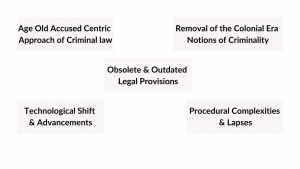
The Indian Penal Code (IPC) was drafted by the chairman of the first Law Commission, Thomas Babington Macaulay. IPC was losing its relevance and had its own questions to fill in, with the change of time. Society has undergone multi-dimensional and layers of changes in terms of various aspects, illustratively medical advancements, technological shifts, socio-cultural understanding, monetary value etc.
Earlier the Penal Code functioned with an approach to punish for the crime in question, even this approach has taken its own turns towards reformation. Certain terms or colonial-era legal provisions have lost the need or effect of their being. The present-day crimes mirror some new kinds and approaches of criminality, owing to a shift in the socio-economic elements, social functioning, technology and technique. As an illustration, cyber-crimes have deepened their roots across geographical boundaries, as a new age crime. The ticking time also called for some reformation and a new age approach towards punishments attached to the crimes in question, e.g. increase in the amount of fines to match up to the present-day value for money and community service as a form of punishment. Hence, the sweep of time called for a sweep of changes to align with the present-day functionalities.
What Called for the Reforms?
The Foundational Features and Legal Provisions of Bharatiya Nyaya Sanhita (BNS)
This year Bharatiya Nyaya Sanhita i.e. BNS, has replaced the Indian Penal Code (IPC) and it came into effect from July 1, 2024.
*(All the provisions of the Sanhita came into force, except Section 106(2) that deals with the hit and run cases i.e. death caused by rash and negligent driving- has been kept on hold and is still not in effect).
Some of the key elements and provisions of BNS are –
- Codified Substantive Law- Bharatiya Nyaya Sanhita, which replaces the old Indian Penal Code (IPC), is a codified substantive criminal law. It provides for acts or omissions that would make a criminal offence and the consequent punishments, fines, or the rights of the victims.
- Structure and Organisation- The Indian Penal Code i.e. IPC had 23 chapters and 511 sections in total. The Bharatiya Nyaya Sanhita, 2023(i.e. BNS), has been framed as a new law- categorized into 20 chapters with 358 sections in total (laying down various legal provisions and offences under the Sanhita).
- Specific Definition Clause and Contextual references- Bharatiya Nyaya Sanhita has a separate section and provision dealing with the definitions for the terms used in the BNS. Section 2 of the Bharatiya Nyaya Sanhita specially lists down all the terms and provides for a contextual reading and understanding of those terms (as an exception), as and where required, according to the other provisions of the BNS.
- Recognizes Transgender- The Bharatiya Nyaya Sanhita, 2023, specifically recognizes ‘transgender’ as a gender alongside ‘men’ and ‘women’ under Section 2(10)– as for reference of pronouns in the Sanhita. IPC identified only ‘men’ and ‘women’ in reference to the definition attached to the term ‘gender’ in the code. This is a welcome change in the approach, as with the changing times, transgender people and their rights have been recognized via various judgments and changes in the society. The apex court recognized the transgender and their right to self –identification in the landmark case of NALSA vs. UOI (2014) (2014 INSC 275).
- Crimes Against Children & Women- The BNS, has specially categorized a specific chapter for offences against women and children as one category, under Chapter 5 of the Sanhita. This includes sexual offences, criminal force and assault, marriage-related offences, miscarriage and crimes against children. Categorizing the offences against children and women together under one chapter ( i.e. chapter no. 5) draws a parallel between the social vulnerability of both and keeps them on an equal footing, owing to the clubbing together of these two as one kind of a category, which has drawn its own criticism from the critics. However, as a fact, these two are vulnerable in terms of exposure to crime in terms of gender-specific offences and age vulnerabilities and hence need specific attention and categorization. Putting the women and children, as one category causes any harm in terms of social or legal perceptions or implications or not, will be tested over time.
- Reformative Form of Justice- Initially, in the colonial era, crime and law were driven by the force to punish and establish a deterrent theory.
However, with the passage of time, the view- views the objective behind the operation of the criminal law and the infliction of punishment have changed. The criminal law aims towards the reformation of the convict and rehabilitation, along with a victim-centric approach. The considered view taken by the courts and the reformative theory is that – every saint has a past and every sinner has a future.
Community service has been added as a new form of punishment under Section 4 of the Sanhita, reflecting a reformative and restorative form of justice in cases involving first-time offenders or lighter offences. - Wider Ambit of Documents- The Bharatiya Nyaya Sanhita has increased the ambit and legal effect of what can be counted as a document. With the leap of technology in the hands of time and digitization of the world, the ambit, the making and the mode of storage, of the documents has widely changed. The definition of the term ‘document’ now includes electronic and digital records (i.e. Section 2(8)).
- Corporeal and Incorporeal Property- Section 2 (21) defines ‘movable property’ to be inclusive of everything, which doesn’t fall within the term ‘immovable property’ and is not qualified by the reference of corporeal property (i.e. “it includes property of every description, except land and things attached to earth or permanently fastened to anything which is attached to earth”). Hence as per BNS, the movable property may be corporeal or incorporeal.
- Increased Extra-Territorial Applicability – The Bharatiya Nyaya Sanhita, now penalises abetment of offence outside (i.e. without and beyond India) India, for the commission of an offence within India. Section 48 of Sanhita, provides for abetment outside India for offences in India- “A person abets an offense within the meaning of the BNS if they, without and beyond India, abet the commission of any act in India which would constitute an offense if committed in India.”
- Consent and Age- As per the Explanation 2 of the Section 375 of Indian Penal Code, sexual intercourse by a man with his wife was punishable if she was under the age of 15 years of age (as otherwise marital rape is not recognized as an offence). However, this was read down by the Supreme Court in Independent Thought vs. Union of India (2017 INSC 1030), and the age was raised to 18 years instead, in this provision (i.e. the age of majority and in consonance with the provisions of POCSO).
BNS has now expressly raised this age of consent in the case of wives- to 18 years (i.e. Exception 2 of Section 63). Though, marital rape except in the case of a wife below the age of 18 years (i.e. age where there is legally no recognition of consent under POCSO), is still not recognized as an offence under the Sanhita. - False Promise To Marry (Section 69) – Bharatiya Nyaya Sanhita has specifically recognized the offence of sexual intercourse on the pretext of any deceitful means, which expressly includes intercourse on a false promise to marry. This is made an offence (though the act is consensual and not rape in itself) as here the very consent for the act is based on deceit and as per the judicial pronouncements such a promise in question, should be false (i.e. with no intention to fulfil) from the very inception.
Recently, in MAHESH DAMU KHARE VS. THE STATE OF MAHARASHTRA (2024 INSC 897), the apex court has asserted that for an act to be an offence of sexual intercourse on false promise to marry- the alleged relationship or intercourse must be proved to be only based and carried on, on the faith of such a false promise to marry. Adding to this the duration of the relationship has to be factored in, as the court opined that in cases of long-standing physical relationships, false promise cannot be certainly claimed to be the basis of carrying on such a relationship. - Gender Neutral References- The word ‘man’ has been replaced by ‘whoever’, for a reference to the offender/accused in Sections 76 and 77 (dealing with offence of Assault or Criminal Force against a woman with the intention of disrobing her and Voyeurism, respectively) of BNS. Hence, a gender-neutral ambit to cover any accused against these specific offences has been adopted in the Sanhita.
Similarly, Section 366A of IPC- provided for the offence of procuration of minor girls. However, Section 96 of BNS deals with offence of procuration of any child (irrespective of gender as the term used is ‘any child’). - Section 106- Medical Negligence– Section 106(1) of Bharatiya Nyaya Sanhita, provides a separate and specific reference to a death caused by the negligence of a medical practitioner, in the course of a medical procedure. The Sanhita tends to construct a comparatively liberal approach in cases of medical negligence as against other cases. It provides for a lesser punishment i.e. imprisonment up to 2 years (simple or rigorous) and a fine.
- Snatching (Section 304) – BNS provides for a separate and specific offence of cases where theft is snatching. The offence of snatching has been on the rise and had become a usual scenario for past some time and hence a separate recognition and provision for this crime is an appropriate approach. It includes seizure, securing, grabbing or taking away of a movable property- for theft.
Section 304(2) of the Sanhita –punishes the person for the offence of snatching with imprisonment up to 3 years (either description) and fine. - Sedition Law- Bharatiya Nyaya Sanhita has removed any reference to the sedition law, which earlier was so termed and was an offence under Section 124A of the old Indian Penal Code. The constitutional validity of the old Section 124A under IPC, was challenged under SG Vombatkere vs. UOI (WRIT PETITION(C) No.682 OF 2021), before the apex court on the basis of Article 14 and Article 21 of the constitution. The constitutional validity of the sedition law was earlier upheld by the Supreme Court in Kedar Nath Singh vs.State of Bihar (1962 INSC 17) However, the grounds of challenge were different and the court considered the validity only on the threshold of Article 19(1)(a) and hence needs a reassessment under the wider and evolved aspects of the constitution.
Considering this the apex court restrained the police from registering any new FIR or registering any cases under 124A IPC. The Supreme Court has referred the petition to a 5 Judge bench, to decide on the validity of the said provision.
Over the aspect and claim of ‘sedition law’ having been removed from the new law (i.e. BNS replacing the IPC)- the Supreme Court still considered the reference to be made essential, as the new criminal law will be prospective in its application and effect, and hence the constitutional validity of the old provision has to be essentially tested for the sake of already registered cases or the ongoing prosecution under Section 124A of Indian Penal Code.
Theoretically, the term and the colonial offence of ‘Sedition’ as worded in the old law finds no place in the Bharatiya Nyaya Sanhita.
However, Section 152 of Bharatiya Nyaya Sanhita, 2023 (i.e. BNS) deals with ‘ Acts endangering sovereignty, unity and integrity of India’.
The provision lays down that – If anyone, purposely or knowingly (i.e. highlights the element of intention, knowledge or object), by spoken or written words, or by signs, or by visible representation, or by electronic communication or by use of financial mean, or otherwise( I.e. it covers all the means of expression and communication including any form of electronic communication and hence projects wide ambit by using the word ‘otherwise’ to cover every possible means that can be used to express or convey), excites or attempts to excite, secession or armed rebellion or subversive activities, or encourages feelings of separatist activities or endangers sovereignty or unity and integrity of India; or indulges in or commits any such act shall be punished with imprisonment for life or with imprisonment which may extend to seven years, and shall also be liable to fine.
Consequently, the provision has a rephrased and new-found place in the Sanhita, with a new name.
Key Omissions: Bharatiya Nyaya Sanhita -A Shift Against The Backdrop of IPC
Some of the provisions and old legal expressions that had turned obsolete or had lost their meaning or intended legal effect or need of reference in substantial criminal law, have been repealed and omitted from the new Bharatiya Nyaya Sanhita, 2023 – including many of the sections or legal expressions that already stood repealed via amendments to the Indian Penal Code.
List of some important omissions
| Section (IPC) | Subject/Provision |
| Section 18 | India |
| Section 50 | Sections |
| Section 53A | Construction of Reference to Transportation |
| Section 124A | Sedition |
| Section 153AA | Knowingly Carrying Arms in Any Procession or Organizing or Holding or Taking Part in Any Mass Drill or Mass Training with Arms. |
| Section 236 | Abetment in India of Counterfeiting Out of India of Coin |
| Section 264 to 267 (Chapter 13) | Offences Related To Weights and Measures |
| Section 309 | Attempt To Commit Suicide |
| Section 310 & Section 311 | Thug |
| Section 377 | Unnatural Offence |
| Section 444 | Lurking House Trespass by Night |
| Section 446 | House Breaking by Night |
| Section 497 | Adultery |
Operational Barriers and Challenges for Bharatiya Nyaya Sanhita, 2023
The new Bharatiya Nyaya Sanhita, 2023 came into operation from July 1, 2024. This substantive law being absolutely new in its legal effects and application, along with some significant additions and changes, will have its own share of practical challenges in effective implementation.
- Logistic Roadblocks- The substantive criminal law (BNS), has expressly recognized the growth in technology. To illustrate, reference to ‘documents’ in BNS now includes electronic and digital records (i.e. Section 2(8)). Handling of such records, different legal and practical implications and varied technological aspects or glitches will be some of the questions that would find their place along the way.
- Deletion of Section 377- Bharatiya Nyaya Sanhita has absolutely removed any reference of the unnatural offences (i.e.Section 377 IPC). Section 377 was partially struck down by the five-judge bench of the Supreme Court in Navtej Singh Johar vs. UOI (2018 INSC 790) (i.e. in cases of consensual sexual intercourse – as it de-criminalised same-sex relationships between consenting adults). However, the rest of the offence was retained i.e. for cases of non-consensual intercourse, bestiality and sodomy. However, BNS fails to consider these acts as an offence, leaving a huge gap prone to misuse and evasion from accountability against criminality.
- Section 152- Wide and Undefined Ambit – Section 152 of BNS, deals with –‘Acts endangering sovereignty, unity and integrity of India.’
The terms used and language are vague, subjective and wide and prone to misuse or miss application by authoritative hands. Section 152 mentions of this offence against – ‘India’ instead of just the ‘government established by law’ and hence widens the scope of activities and effect. There is no explanation or specific definition attached to reflect what exactly falls within the ambit of- ‘subversive activities’ or ‘separatist activities’. The provision will find its true construct and its ambit with time via various judicial pronouncements. - Community Service- Community Service has been added as a new form of punishment under Section 4(f) in the BNS. However, the Sanhita has neither any provision or reference as to what acts would fall within the definition of this ‘community service’ nor does it provide for the mode and method of its administration and continuous supervision.
- Conflicting Duplication – The BNS being the general criminal law dealing with offences, has made a reference to some offences which are also dealt and punished by existing special laws, which leads to duplication of provisions. For example, the Bharatiya Nyaya Sanhita provides for offences of ‘organised crimes’ and ‘Terrorism’ (Section 111 to 113). However, these offences are already dealt with, by special laws along with special criminal procedures along with stringent and required procedural expertise and safeguards. This leads to an unwanted overlap and an approaching conflict in future cases.
Conclusion
Concluding, the Bharatiya Nyaya Sanhita, 2023, which has replaced the old Indian Penal Code was very much the need of the time. BNS has been framed according to the technological shifts and advancements and the changes in the socio-economic sentiment or the approach towards criminality or the new offences or modes of offences, along with requisite alterations and omissions. The new structure is bound to have its own issues in legal implementation, as all the future scenarios are not predictable. The provisions will be open to judicial and legal commentaries and interpretations and will adapt to the intended legal effect.
Explore the Best Books & Commentaries on Bharatiya Nyaya Sanhita, 2023 at LexisNexis
For detailed insights and comparative understanding of Bharatiya Nyaya Sanhita, 2023, choose from the best available books & commentaries at LexisNexis-
The Bharatiya Nyaya Sanhita (BNS), 2023 (45 of 2023)
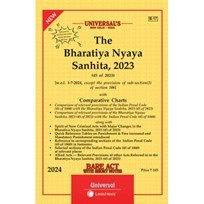
To read and know the provisions of Bharatiya Nyaya Sanhita, 2023- bare act is a must have. The bare act comes with tabular comparison and short comments over the relevant provisions.
Ratanlal & Dhirajlal’s The Bharatiya Nyaya Sanhita 2023, 36th edition
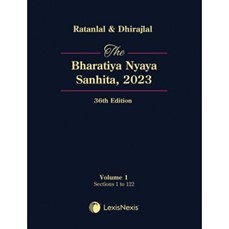
A trusted classic for reference over the subject, lucid & exhaustive for the readers. The notable commentary is an essential and celebrated resource for criminal law. The book provides for comprehensive commentary on new provisions of the BNS and the old retained provisions of the Indian Penal Code. The updated edition provides for an authoritative analysis of the new law, while it retains its classic essence, which makes it a favourite amongst readers.
The Bharatiya Nyaya Sanhita, 2023 (45 of 2023) & The Indian Penal Code (45 of 1860): A Comparison” by Bharat P. Maheshwari
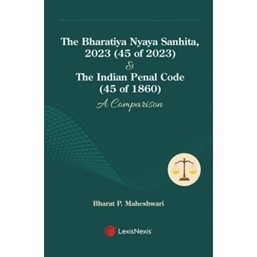
The commentary by Bharat P Maheshwari is a comprehensive and trusted legal resource published by LexisNexis. The format and lucid writing caters to needs of the potential readers and includes side by side comparative references, charts and highlighted changes.
Textbook on The Bharatiya Nyaya Sanhita, 2023 by K D Gaur
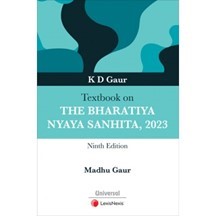
An exhaustive and authoritative commentary on the new provisions of BNS along with the old provisions that have been retained from the Indian Penal Code, for a complete and comprehensive understanding of the new law in force. For a reader friendly reference, the book comes with tabular comparison and highlights the relevant changes in the legal provisions. K D Gaur’s textbook comes with legal annexures providing for the rights of accused, compensation to the victims of crime and guidelines to effectively study and understand criminal law.
Concise Commentary on The Bharatiya Nyaya Sanhita 2023 by Anjana Prakash & Anuj Prakaash
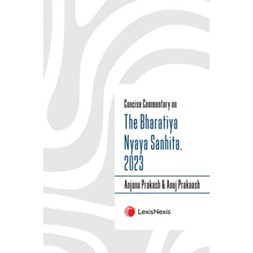
A well structured commentary with comparative legal provisions and details and has been written in a format that lies between bare act and a voluminous commentary, and hence can be a preferred choice for readers who need brevity and yet a complete coverage over the subject. The commentary provides a comparative reference to the provisions of the old law i.e. Indian Penal Code, at relevant places.