Latest Articles

Summary What are Legal AI Workflows? How Legal AI Workflows Differ from Task-Based AI Tools What Legal AI Workflows Look Like in Practice Why Workflows Matter in New Zealand Legal Practice ...

Summary Employee Engagement is Falling as AI is Rising The Human Side of AI Adoption Accelerating Onboarding and Upskilling Increasing Job Satisfaction Through Smarter Tools Empowered Teams...

Summary Who needs to be in the room The leading lights of AI research Procurement as power The case against light-touch regulation Regulation as a verb What lawyers will take away Five...
Summary When executive power goes unchecked A chance for solidarity among common law jurisdictions New Zealand at the forefront Beyond the minutiae The human connection Creating environments...
Summary The empathy advantage From server to cloud Competing with larger machines The Ferrari and the potholes The enduring powers problem The constant foundation Originally published...
Summary
- The problem with platform hopping
- How the models differ
- Security without compromise
- Beyond legal research
- The speed of adoption
Originally published by NZ Lawyer. Republished with permission.
Beneath the surface of the New Zealand legal profession’s growing AI fluency sits a blind spot: sensitive data is drifting across too many platforms. Many lawyers are using legal generative AI tools such as Lexis+ AI® with Protégé to great effect, but alongside general AI tools like ChatGPT, potentially exposing sensitive client data to different platforms with varying security standards.
Protégé General AI, launched on 25 November, aims to shut that vulnerability down. By bringing enterprise versions of GPT-5, GPT-4o, OpenAI o3 and Claude Sonnet 4 into the same secure environment as its legal research products, LexisNexis promises to give lawyers the flexibility they want without the data-security trade-offs they’ve been making.
The move follows mounting evidence, both locally and globally, that professionals are already using multiple AI models for different tasks, often in ways that risk breaching ethical duties. Protégé General AI responds to that reality with a consolidated workflow, consistent privacy protections, and guardrails to prevent hallucinated citations, setting a new benchmark for how the profession can use AI safely.
"We realised customers were using a lot of different open-source AI models while handling sensitive client data," said Alastair Fernandes, product manager at LexisNexis New Zealand.
Lawyers, like the rest of the population, are learning that different AI tools excel at different types of tasks. Legal professionals will switch between different open-source AI models leveraging the strengths of each to improve their work. But the data security stakes for lawyers are much higher – such practices could breach professional obligations and expose firms to significant liability, not to mention betray client expectations.
The problem with platform hopping
The fragmented approach invites security risks and leads to productivity losses as lawyers spend time navigating and cutting-and-pasting between tools. Lawyers download case resources from one platform, upload them to another for analysis, then switch to a third tool for client communications. Each transition represents a potential breach point for confidential information.
Context switching also disrupts the flow of legal work. Fernandes explained that lawyers might research Commerce Commission enforcement actions on one platform, then need to switch to another environment entirely to draft client advice based on those findings.
"That fragmented workflow is what we're trying to mitigate," he said.
The new feature eliminates these transitions. Legal professionals can now access GPT-5, GPT-4o, OpenAI o3, and Claude Sonnet 4 directly within the Lexis+ AI platform, alongside the company's established legal research databases.
How the models differ
Each AI model serves distinct purposes, and LexisNexis has built a simple dropdown menu that lets lawyers select the right tool for each task. GPT-5 excels at strategic reasoning and connecting disparate facts, while also providing real-time web search results. OpenAI o3 offers deep research capabilities for breaking down complex legal arguments or analysing intricate fact patterns. Claude Sonnet 4 is adept at writing for marketing communications or social media releases.
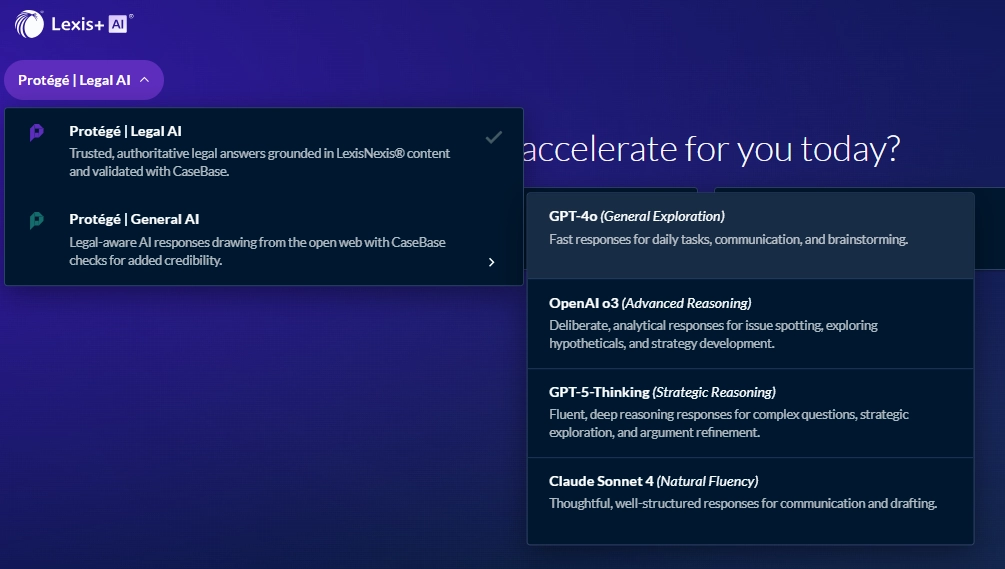
The practical applications become clear when considering typical workflow scenarios. A corporate lawyer handling a merger might use GPT-5 to analyse regulatory implications through web searches, switch to Legal AI for Companies Act 1993 research, then use Claude Sonnet 4 to explain the deal structure to clients in plain English—all within the same browser tab.
With the release of Protégé General AI, a drop-down menu allows the user to choose the general AI tool themselves. The choices are:
- Claude Sonnet 4 (Natural Fluency)
Provides thoughtful, well-structured responses with natural fluency, ideal for everyday communication and brainstorming tasks that require a diplomatic touch. - GPT-5 (Unified Reasoning)
The latest model from OpenAI, which combines strong general knowledge and conversational ability with deep analytical thinking, making it suited for strategic exploration and refining complex arguments. LexisNexis is among the first companies to integrate this model through its direct collaboration with OpenAI. - GPT-4o (General Exploration)
Offers fast, conversational responses ideal for brainstorming, client communications and everyday tasks. Whether drafting professional emails or summarising complex documents for partners, this configuration prioritises speed and natural language. - OpenAI o3 (Advanced Reasoning)
Delivers deliberate, analytical responses using OpenAI's Deep Research, a sophisticated AI capability designed for complex research tasks. It excels at issue spotting, exploring hypotheticals and framing legal strategies, which are particularly valuable when working through multi-step problems or analysing fact patterns.
Security without compromise
The platform maintains the same encryption standards across both its legal and general AI features. User’s prompts and content is encrypted, and no customer data is used to train AI models.
The platform includes a CaseBase® Case Citator service that checks any legal citations returned by General AI web searches against the company's authoritative legal database. When the system encounters a case citation it cannot verify, it flags the reference for the user to investigate further.
This helps get around the problem of public source AI tools citing cases that are dubious or not relevant in a local context.
Beyond legal research
The breadth of tasks lawyers can now handle within a single platform extends well beyond traditional legal research. Fernandes described scenarios where professionals might draft compliance risk assessments, build meeting agendas for clients, or create internal presentations—work that sits adjacent to core legal tasks but doesn't require citing case law.
"When you're drafting a compliance risk assessment, you're looking at scenario planning or policy analysis—you're looking at the business of the client, and you're not drafting a legal specific requirement," he said.
The company has also expanded its Legal AI capabilities with several features that complement the General AI launch. Transactional document Drafting now allows lawyers to create entire contracts by drawing from LexisNexis's database of precedent templates. Timeline Visualisation helps litigators build chronologies of case events from multiple uploaded documents.
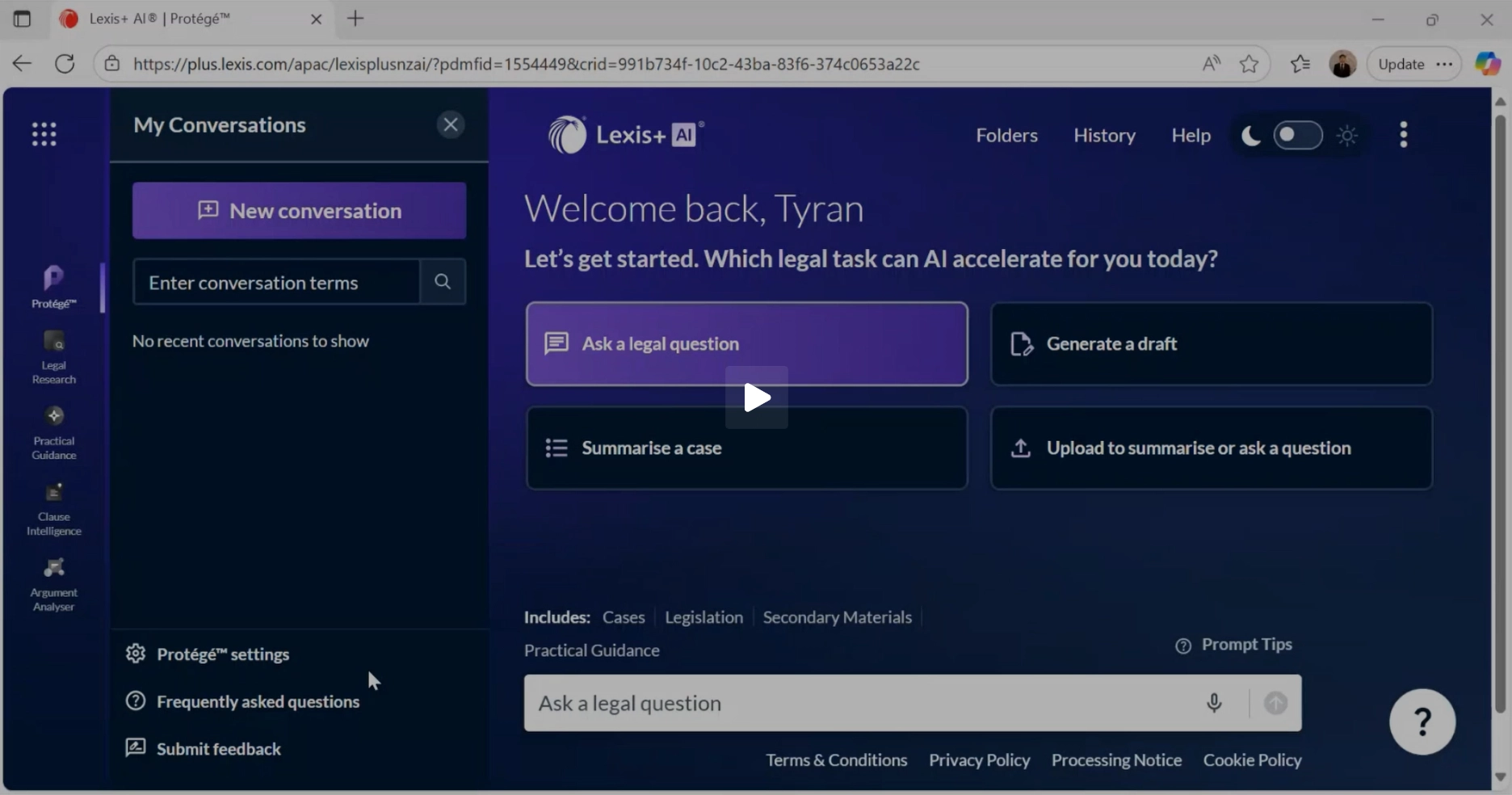
"Vaults are a significant expansion of Protégé Legal AI’s upload functionality," Fernandes said. "It has the ability to summarise issues within those documents, extract arguments and compare and contrast the benefit with Vault is that it's a secure, private workspace to upload a large number of documents with data.
The speed of adoption
The November launch is something of a record for LexisNexis's New Zealand operation. Typically, features developed in the US take six to eight months, sometimes a year, to reach local markets. General AI arrives just three months after its US commercial preview.
"This is genuinely a fast follow," Fernandes said, noting that the business environment around AI products demands that these richer features be rolled out to global markets as quickly as possible.
The accelerated timeline reflects how quickly AI has become essential infrastructure for legal work. Fernandes described an emerging reality where legal professionals interact with AI products daily, creating competitive advantages for early adopters.
All existing Lexis+ AI with Protégé users will receive access to General AI at no additional cost, despite gaining enterprise-level access to models that would typically require separate subscriptions and costs.
"We're trying to make sure that Lexis+ AI with Protégé becomes a comprehensive solution that lawyers are using in their day-to-day life, that they don't need to jump between or buy different services," Fernandes said.
The company plans continued education around which models work best for specific tasks, an area where the profession is still developing fluency.
"Everyone is becoming AI native or AI fluent," he said. "We're training internally, but we're also going, okay, what have we found really good and what have we found really useful when we're using Claude? How does Claude compare to GPT-4o?"
A future phase might introduce a blended approach where the platform automatically selects the optimal model based on the user's prompt. For now, the focus remains on transparency and choice, ensuring lawyers understand which tool is generating each response.
Learn more about Protégé General AI and see it in action by requesting a free demo using the form below: