
23 Jan 2026
New Case Tags Expand Securities Litigation Insights
Federal securities litigation continues to be one of the most complex and consequential areas of U.S. law. From class actions alleging misleading disclosures to enforcement matters involving regulatory scrutiny, practitioners need reliable data to understand risk, benchmark outcomes, and uncover meaningful business development opportunities. With powerful data from Lex Machina®, the LexisNexis® Legal Analytics® platform, legal and insurance professionals have the clarity they need.
Our platform now provides insights into more than 30,000 commercially relevant federal securities lawsuits, covering both private litigation and government enforcement actions. This breadth allows attorneys to move beyond anecdotes and instead rely on empirically grounded intelligence drawn directly from federal courts.
Expanded Case Tagging for Securities Litigation
To further enhance analytical precision, Lex Machina has introduced three new case tags for federal securities litigation. These tags enable professionals to rapidly identify, filter, and analyze cases based on the specific statutory claims at issue.
-
Section 11 / Section 12
Securities cases involving material misstatements or omissions brought pursuant to Section 11 or Section 12 of the Securities Act of 1933, codified at 15 U.S.C. § 77k and 15 U.S.C. § 77l, respectively. These claims frequently arise in connection with public offerings and registration statements and are central to assessing disclosure-related risk.
-
Section 14
Securities cases involving misstatements, omissions, or other violations related to proxy solicitations or shareholder voting brought pursuant to Section 14 of the Securities Exchange Act of 1934, codified at 15 U.S.C. § 78n. These matters are particularly relevant in merger challenges and contested corporate governance disputes.
-
Section 20(a)
Securities cases alleging control person liability brought pursuant to Section 20(a) of the Securities Exchange Act of 1934, codified at 15 U.S.C. § 78t(a). This tag allows practitioners to analyze how courts address derivative liability claims against executives, directors, and other alleged control persons.
With these tags, legal and insurance professionals can quickly and easily isolate trends, compare outcomes, and evaluate strategies across highly specific subsets of securities litigation.
“In securities litigation, meaningful analysis depends on excluding as much as it does on including,” said Laura Hopkins, a legal data expert for Lex Machina. “By tagging cases at the statutory-claim level, Lex Machina allows practitioners to eliminate irrelevant matters, isolate Section 11/12, Section 14, and Section 20(a) claims with precision, and rely on a clearer, more accurate data set when assessing trends, outcomes, and litigation risk.”
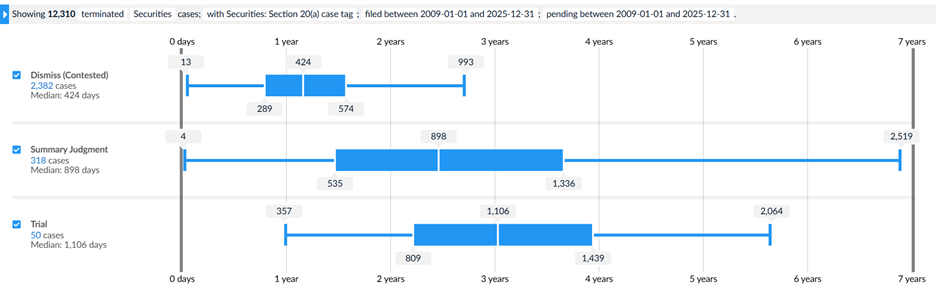
Lex Machina delivers powerful insights into how tens of thousands of federal securities lawsuits resolved, including who won, how much, by what means, how long it took, and more.
Actionable Analytics for Litigation Strategy and Business Development
Legal and insurance professionals using Lex Machina can analyze filing trends, motion outcomes, time to key milestones, damage awards, remedies, and party-level behavior across jurisdictions and judges. This enables litigators to assess the strength of potential claims or defenses and to advise clients with greater confidence.
Just as importantly, these insights support lawyers’ business development efforts. Firms can identify which companies, industries, or claim types are driving new filings, spot enforcement trends before they crest, and demonstrate subject-matter credibility using real-world data. Whether pitching to prospective clients or expanding an existing relationship, attorneys can use Lex Machina to showcase their own litigation experience as well as demonstrate that their advice is informed by the full landscape of federal securities litigation.
Turning Data Into Advantage
In a practice area where stakes are high and scrutiny is constant, data-driven insight is no longer optional. By combining comprehensive coverage, refined case tagging, and powerful analytics, Lex Machina helps securities litigators transform complex litigation data into a strategic and competitive advantage.
Ready to discover what trends in recent litigation mean for your team? Click here.