Policy or no policy—AI gets used
Employees are not waiting for their company to provide them with approved genAI tools. If the tools aren’t provided, employees will use their own.
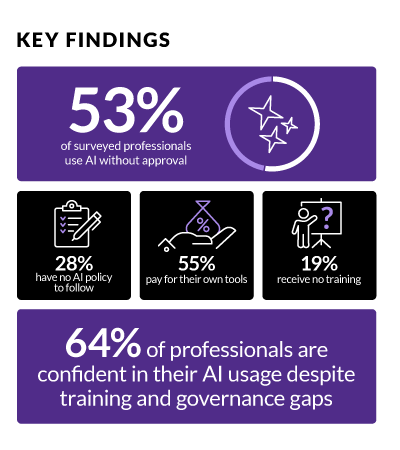
While 82% of surveyed professionals are open to the benefits AI can provide, training and policy have failed to keep pace with adoption. This report explores three key consequences of that gap and outlines practical actions leaders can take now.
Employees are not waiting for their company to provide them with approved genAI tools. If the tools aren’t provided, employees will use their own.
Most professionals claim they are confident in using genAI responsibly. But our research suggests many of the same professionals don’t fully realize the security risks associated with their nonapproved, personal tools.
The majority of our respondents say AI training is limited to certain departments, creating inequality and inconsistency across the organization.
The defining shift of 2026 is the evolution from asking “Can genAI do this?” to “Should we trust how it does this and are we protected?”
Download the report to explore how your company may be at risk if proper AI policy isn’t in place—no email required.
Employees are expected to use genAI, but only 23% of surveyed professionals receive mandatory training. Even among employees who are confident in using genAI tools, their trust in the accuracy of the outputs remains uneven.
"We are expected to use it, yet there are no guidelines for its use or demonstrative value that makes its use worthwhile. "

Where is your organization on the AI journey?
Answer 11 questions to discover your AI persona. Uncover your strengths and weaknesses, and explore curated content tailored to your stage.
Fill out the form to receive an industry report tailored to your field. Discover how genAI is impacting professionals like you in the following industries:
LexisNexis, a division of RELX Inc., may contact you in your professional capacity with information about our other products, services, and events that we believe may be of interest. You can manage your communication preferences via our Preference Center. You can learn more about how we handle your personal data and your rights by reviewing our Privacy Policy.