
Home > Data Glossary > Retrieval-Augmented Generation

What is retrieval-augmented generation (RAG)?

Retrieval-augmented generation (RAG) is an artificial intelligence (AI) technique that combines information retrieval with large language model (LLM) generation. Rather than relying only on pre-trained model parameters, RAG acquires relevant external data from a knowledge base, vector database, or enterprise repository, and injects it into the model’s context window before generating a response. 

By doing so, RAG provides a trusted context for AI outputs to improve accuracy, reduce hallucinations, and provide verifiable citations. 


Why is RAG important?

Generative AI models are powerful, but they are prone to “hallucinations”—answers that are convincing but inaccurate. In high-stakes environments like legal research, due diligence, compliance, and investigative journalism, this can create risk.

RAG reduces these risks by:
  • Anchoring responses in verifiable data, providing context and citations for the output. 
  • Enabling domain adaptation without retraining models, saving time while ensuring accuracy. 
  • Supporting compliance with citation and audit requirements, meeting necessary standards. 
  • Increasing user trust in AI outputs, establishing more reliable processes.

How does RAG work?


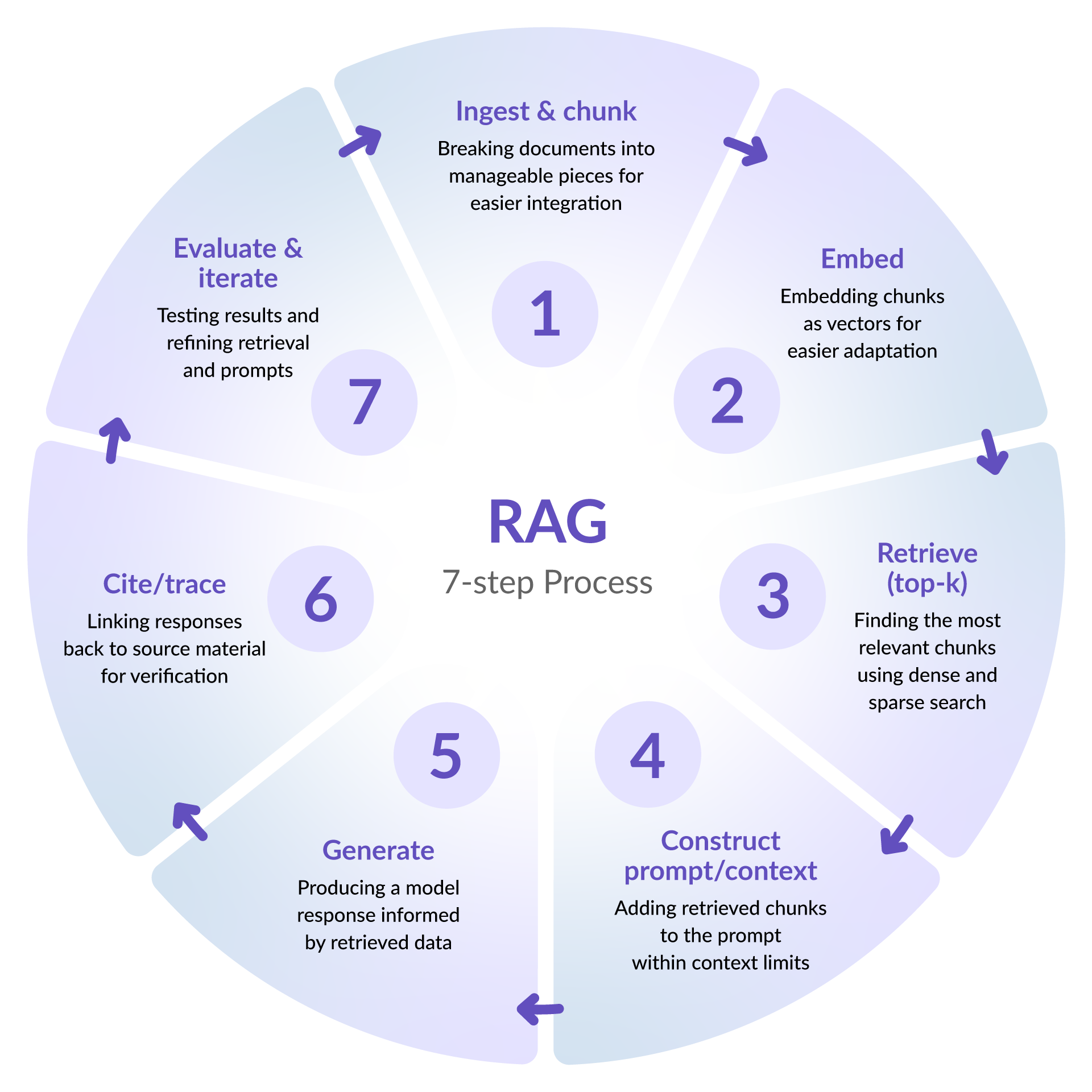
RAG typically follows a seven-step process: 

  1. Ingest & chunk: Breaking documents into manageable pieces for simplified data integration 
  2. Embed: Converting chunks into vector representations using an embedding model to enable simple adaptation 
  3. Retrieve (top-k): Mining the data to find the most relevant chunks for a query, using both dense and sparse search, to improve recall and pinpoint pertinent information 
  4. Construct prompt/context: Inserting retrieved chunks into the model’s prompt for the correct context. Creating context windows limits how much retrieved text can be passed through the model 
  5. Generate: Producing a response through the LLM informed by the retrieved data 
  6. Cite/trace: Providing references back to the source material for verification and increased accuracy. 
  7. Evaluate & iterate: Testing performance, refining retrieval, and improving prompts.

 This process is cyclical, allowing the RAG to evolve and improve as the retrieval processes are refined and knowledge is updated.


Key components of RAG

In order to operate effectively, RAG has four main components that work together to guide the core workflow: 

  1. Retriever: The element responsible for locating pertinent information. It can be sparse (keyword), dense (embeddings), or hybrid. Parameters like ‘k’ (number of results) and filters control precision and recall.
  2. Knowledge store: A collection of relevant data. It is typically a vector database, enterprise search index, or proprietary collection. The knowledge store support metadata, access controls, and security compliance.
  3. Generator: The LLM that produces text. Choice depends on domain, token costs, and temperature settings.
  4. Orchestration layer: Coordinates retrieval and generation of data and documents, applies prompt templates, routes queries, and enforces guardrails with the models. Together, these four components allow for the efficient production of a RAG model.

What are the benefits of RAG?

Using a RAG model presents plenty of benefits for organizations looking to implement more artificial intelligence systems into their workflows:

  • Higher factual accuracy thanks to grounding responses in verifiable data 
  • Source-backed answers with citations, creating more trust
  • Rapid updates without retraining, making systems more efficient 
  • Domain-specific knowledge integration, ensuring relevance of responses

What are the limitations & risks of RAG?

While RAG is noted for its improved accuracy and ability to provide greater context for responses, there are limitations and risks associated, including:

  • Incomplete answers due to potential gaps in retrieval
  • Increased latency when multiple retrieval steps are added
  • Sensitive data risks if PII or privileged content is not properly filtered
  • Users may over-trust citations without verifying context

As with all artificial intelligence integration, human oversight is needed to ensure quality and accuracy.


How to implement RAG

The implementation and creation of RAG systems can be internally built or purchased through an outside provider. There are benefits to each approach.

Factor 

Build 

Buy 

Control 

Full customization 

Pre-built integrations 

Speed 

Longer setup 

Faster deployment 

Maintenance 

Ongoing upkeep 

Vendor-managed 

Compliance 

Custom to jurisdiction 

Vendor-certified 


The right approach for your organization will depend on your resources, requirements, personnel, and available time for deployment. 


What are the best practices for RAG?

To ensure the greatest success with RAG processes, consider: 

  • Using consistent chunking strategies for simplified document incorporation. 
  • Selecting embeddings created for semantic similarity. 
  • Applying hybrid retrieval strategies for broader recall.
  • Designing prompts with clear instructions and citations, ensuring consistent quality. 
  • Caching frequent queries to reduce latency. 
  • Enforcing security with role-based access, establishing increased systems for risk management. 

How to evaluate quality for RAG

Various metrics and testing approaches can be used to measure the quality of your RAG systems:

Metrics

  • Recall@k / Precision@k: Measures whether the retriever includes the correct documents among the top-k results, balancing completeness and relevance. 
  • Groundedness: Degree to which generated outputs align with retrieved passages, often scored via human annotation or automated semantic similarity checks. 
  • Faithfulness: Extent to which answers avoid introducing unsupported claims; sometimes measured with LLM-as-judge methods. 
  • Speed & cost efficiency: Time taken and compute cost per query, including retrieval and generation steps. 
  • User satisfaction scores: Feedback from end users on clarity, accuracy, and usefulness. 
  • Coverage: Proportion of domain knowledge represented in the retrievable data. 

Testing approaches

  • Golden datasets of Q&A pairs: Use expertly curated question–answer sets as a benchmark to measure retrieval accuracy and answer quality. 
  • Synthetic evaluation sets: Generate large, diverse test queries and answers automatically to quickly stress-test the system. 
  • Human-in-the-loop review: Have human experts assess outputs for accuracy, nuance, and trustworthiness beyond automated metrics. 
  • A/B testing against baseline search systems: Compare RAG responses with traditional search or prior systems in real-world use to validate improvements. 

RAG compliance & governance

To ensure consistent quality and limit risk, it is important to establish guardrails for trusted RAG implementation:

  • Data residency and sovereignty requirements: Ensure data is stored and processed in compliance with local jurisdiction laws. 
  • Legal privilege and confidentiality: Prevent RAG outputs from exposing sensitive or privileged information. 
  • Audit trails for retrieval and output: Log all queries, sources, and responses for traceability and regulatory audits. 
  • Access controls on sensitive datasets: Restrict retrieval and generation to authorized users through role-based permissions. 

Common use cases for RAG

Retrieval-Augmented Generation can be used to assist professionals in data collection in a variety of fields, including:

  • Competitive intelligence research: Company profile data with source citations 
  • Enhanced due diligence: Pulling structured intel into AI-generated summaries 
  • Customer support: Retrieving product manuals for accurate chatbot answers 
  • Policy & HR: Centralized knowledge for consistent employee communications 
  • Consulting research synthesis: Literature review and summarization 

What’s the difference between RAG and fine-tuning?

While exhibiting similar properties, RAG offers different has some key differences to other artificial intelligence techniques.

Feature 

RAG 

Fine-tuning 

Goal 

Ground responses in fresh data 

Specialize model knowledge 

Data need 

Document corpus 

Labeled datasets 

Maintenance 

Ongoing ingestion 

Retraining cycles 

Latency 

Moderate 

Low 

Risk 

Retrieval gaps 

Outdated model 


Retrieval-augmented generation summary

Term 

Retrieval-Augmented Generation 

Definition 

Combines information retrieval with generative AI to ground outputs in external sources 

Used By 

Data scientists, researchers, compliance teams, knowledge managers 

Key Benefit 

Improves factual accuracy and provides citable, trustworthy AI responses 

Example Tool 

Nexis+ AI, Nexis Data+


How LexisNexis can help with RAG

LexisNexis can help ensure your AI insights are built on a foundation of credible data. Whether you're interested in leveraging the LexisNexis library of business, news, and legal content within your own AI models of ours, we have a solution for you.

Nexis+ AI

Nexis+ AI applies RAG to business research, grounding outputs in trusted, authoritative sources. Research teams benefit from enhanced accuracy, natural language queries, and transparent citations—all built on decades of LexisNexis expertise. With Nexis+ AI, organizations can: 

  • Uncover insights quickly using natural language queries and semantic search. 
  • Contextualize knowledge by linking relevant legal, news, and business intelligence. 
  • Reduce research time by surfacing the most relevant, authoritative results first. 
  • Support compliance and governance with reliable, curated sources. 

By embedding Nexis+ AI into a RAG framework, organizations can ground data in relevant contexts, creating a more accurate and reliable framework.

Nexis Data+

Nexis Data+ provides high-quality, licensed datasets that enrich RAG workflows across industries. By supplying structured legal, news, and business content, it ensures that generative AI outputs are anchored in reliable, compliant information. With Nexis Data+, organizations can:

  • Discover flexible data delivery, customized for your organization 
  • Access a vast array of reliable data from a single provider 
  • Turn data into actionable insights for a strategic advantage 

Frequently asked questions

Not always—RAG can adapt models without retraining, though fine-tuning may help for style or domain-specific phrasing.

RAG requires enough to cover your target knowledge domain. Performance depends on retrieval recall 

Yes, if configured to return references alongside retrieved passages. 

Yes, provided access controls, redaction, and audit logging are in place.

Equip your AI models with data you can trust

Connect with a LexisNexis expert to discuss how to best support your organization's AI and RAG initiatives.

LexisNexis, a division of RELX Inc., may contact you in your professional capacity with information about our other products, services, and events that we believe may be of interest. You can manage your communication preferences via our Preference Center. You can learn more about how we handle your personal data and your rights by reviewing our Privacy Policy.