Latest Articles
Summary Getting on the AI bus The end of scut work Billable hours under scrutiny Resolve early, fight less – and get on with your life Funding justice beyond the courtroom Originally...

Summary What are Legal AI Workflows? How Legal AI Workflows Differ from Task-Based AI Tools What Legal AI Workflows Look Like in Practice Why Workflows Matter in New Zealand Legal Practice ...

Summary Employee Engagement is Falling as AI is Rising The Human Side of AI Adoption Accelerating Onboarding and Upskilling Increasing Job Satisfaction Through Smarter Tools Empowered Teams...

Summary Who needs to be in the room The leading lights of AI research Procurement as power The case against light-touch regulation Regulation as a verb What lawyers will take away Five...

Summary When executive power goes unchecked A chance for solidarity among common law jurisdictions New Zealand at the forefront Beyond the minutiae The human connection Creating environments...
Summary
- What are Legal AI Workflows?
- How Legal AI Workflows Differ from Task-Based AI Tools
- What Legal AI Workflows Look Like in Practice
- Why Workflows Matter in New Zealand Legal Practice
- What Protégé Workflows Will Enable
The use of artificial intelligence in legal practice continues to mature.
While early adoption focused on discrete applications such as drafting assistance, document summarisation, and research support, attention is increasingly shifting toward how AI can support legal work in a more structured and dependable way.
This shift has brought legal AI workflows into sharper focus.
Rather than supporting isolated tasks, workflow-led approaches are designed to align AI assistance with established legal processes, enabling research, drafting, review, and verification to take place within a coherent framework.
For legal professionals across New Zealand, this reflects a growing emphasis on consistency, accountability, and trust in AI-supported work.
In response to this changing need, LexisNexis® is focusing its legal AI development on workflow-led models that are grounded in authoritative content and aligned with professional standards.
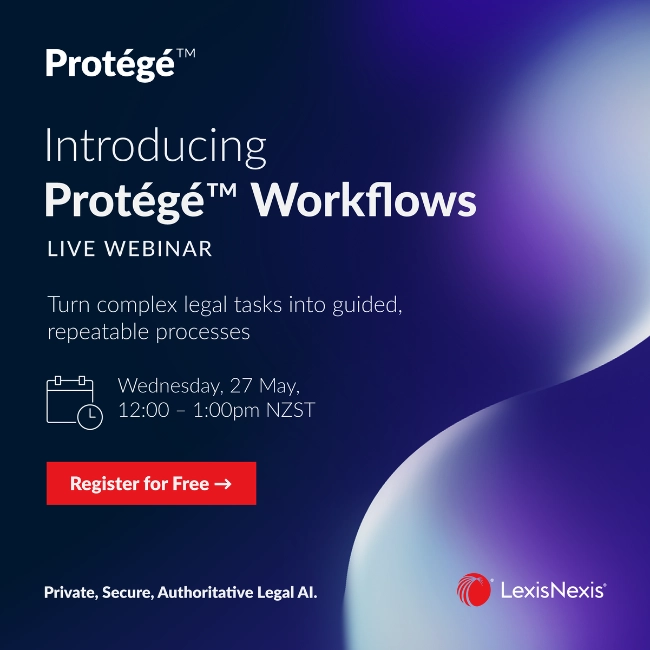
LexisNexis recently announced the global launch of Protégé Workflows, marking a significant step forward in how legal work can be supported through trusted, workflow-led AI. Initial workflow functionality is expected to become available to New Zealand users in the coming months as part of this ongoing evolution.
What are Legal AI Workflows?
A legal AI workflow can be best understood as a structured, AI-supported process that guides legal work from start to finish.
Unlike traditional AI tools that respond to a single instruction, workflows support a sequence of related tasks that together form a legal outcome.
It typically moves through multiple stages, from identifying relevant law and analysing facts to drafting, reviewing, and validating final outputs.
Workflow-led AI is designed to support this progression, rather than fragmenting it across disconnected tools.
Most importantly, workflows are repeatable.
They allow legal teams to apply consistent approaches across matters while retaining professional judgment at each stage. This repeatability is particularly valuable in environments where auditability, risk management, and quality control are essential.
How Legal AI Workflows Differ from Task-Based AI Tools
Task-based AI tools demonstrate how AI can assist with specific activities, such as drafting a clause or summarising a document, and can meaningfully reduce time spent on routine work.
However, they still require the lawyer to manage the overall process.
The responsibility for stitching together outputs, checking sources, validating citations, and ensuring consistency across a matter remains largely manual.
In practice, this means the efficiency gain is often isolated to a single step, while the broader coordination and risk management burden stays with the individual user.
Workflow-led AI represents a structural shift away from this fragmented model.
Rather than producing standalone outputs, workflows embed guidance, sequencing, and checkpoints directly into the legal process. Research, drafting, verification, and review are connected within a defined framework, with validation built in rather than added retrospectively.
For many legal teams, this approach enables AI to scale without undermining professional standards or increasing exposure to risk.
Related: See insights on selecting legal AI tools for your team.
What Legal AI Workflows Look Like in Practice
The value of legal AI workflows becomes clearest when viewed through the lens of everyday legal work.
In litigation, for example, workflows can support the analysis of pleadings against governing law, helping lawyers identify relevant authorities and frame arguments before moving into drafting.
They can also assist with preparing for hearings by synthesising large volumes of documents, surfacing key facts, and validating cited law as work progresses.
This reduces the need to repeatedly move between tools and manual checks, while maintaining confidence in the underlying legal analysis.
In transactional and advisory contexts, workflow-led AI can guide drafting by drawing on established templates, precedents, and authoritative sources.
It can assist with reviewing agreements to identify potential risks or inconsistencies, summarising changes between document versions, and supporting due diligence by extracting and organising key information.
Importantly, these workflows are designed to operate within the context of professional standards, allowing lawyers to review, refine, and validate outputs at each stage.
For more general legal work, workflows can support tasks such as drafting client communications, summarising interviews or witness statements, extracting timelines from complex documents, and organising research and next steps within a matter.
Across these use cases, the defining feature of legal AI workflows is not automation for its own sake. It is the ability to turn established legal best practices into repeatable, reliable processes that lawyers can trust and apply consistently across matters.
Related: Courage, compassion and cloud computing - one lawyer's journey through change
Why Workflows Matter in New Zealand Legal Practice
New Zealand legal practice places strong emphasis on precision, authoritative sources, and professional accountability.
These expectations shape how AI can be used responsibly.
Workflow-led AI is designed to operate within these constraints. By grounding outputs in trusted legal content and supporting verification throughout the legal process, workflows reduce the risk of unsupported analysis or inappropriate reliance on generic information.
They also allow firms and in-house teams to embed their own standards and governance frameworks directly into AI-assisted work.
What Protégé Workflows Will Enable
With the introduction of Protégé Workflows, LexisNexis is advancing workflow-led legal AI by supporting end-to-end legal work within a single, governed environment.
Initial workflow functionality is expected to become available to New Zealand users in the near term as part of a broader global rollout.
Through the commercial roll out in NZ, customers will have access to pre-built trusted workflows that bring together prompting, drafting, review, citation checking, and broader AI capabilities into scalable, repeatable legal processes.
With Protégé Workflows, legal professionals can:
- Run and configure workflows across litigation, transactional, and everyday legal tasks
- Draft memos, discovery materials, contracts, and clauses with structured, step-by-step guidance
- Analyse complex documents and surface key facts and insights efficiently
- Build no-code, custom workflows that reflect firm best practices
- Work within a private, secure AI environment grounded in trusted LexisNexis authority
These capabilities are designed to support legal professionals wherever they work, whether starting with their own documents or with authoritative LexisNexis content.
As workflow-led legal AI continues to take shape, many legal teams are beginning to consider how these approaches could be applied within their own practice.